By Ben Deatherage
WASECA, Minn. (May 14, 2026) — The highways out of southern Minnesota run long and flat, cutting through fields that seem to stretch forever.
On summer weekends, those roads lead in every direction.
North toward Arlington.
West toward Worthington.
South into Iowa.
And more often than not, somewhere along those roads, Todd Stinehart is hauling a race car.
Not because he has to.
Because he loves it.
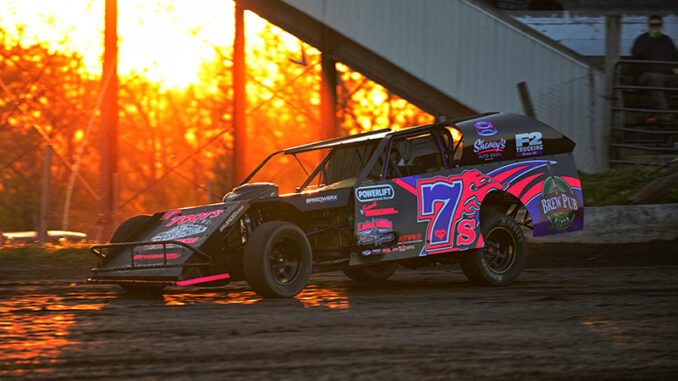
The No. 7S Karl Kustoms IMCA Modified has become a familiar sight across the Upper Midwest, rolling into pit areas at places like Kossuth County Speedway, Hancock County Speedway, Arlington Raceway, and Worthington Speedway, where in 2025 Stinehart finally achieved something that had eluded him for three decades.
A track championship.
Thirty years after climbing into a race car for the first time.
“Thirty years and that was my first track championship,” Stinehart said. “It’s something I never really thought I would do.”
For a driver who has spent most of his racing life doing things his own way — loading the trailer himself, working on the car himself, driving to races himself — it meant more than just a trophy.
It meant every mile had been worth it.
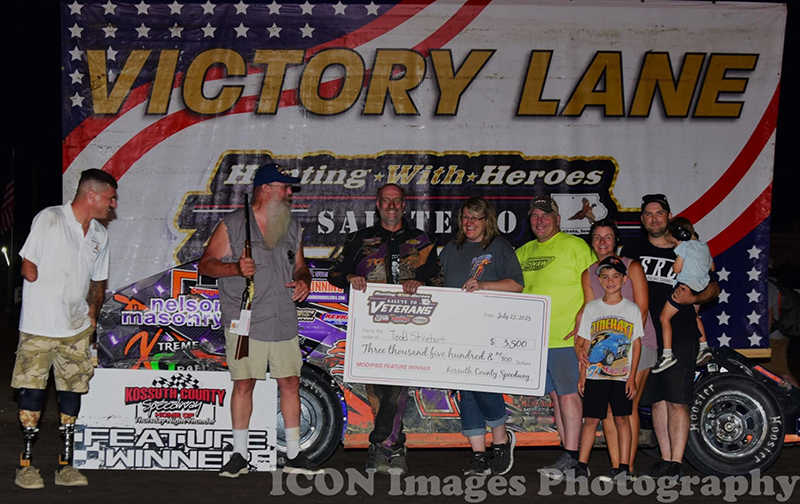
Todd Stinehart celebrates his July 27, 2023 Karl Kustoms IMCA Modified Salute to Veterans feature victory at Kossuth County Speedway with family and crew. (Photo by Icon Images Photography)
Where It Started
Stinehart’s connection to racing began long before he ever owned an IMCA Modified.
“My love for racing started with my dad,” he said.
His father, David, lived near Sioux Falls, and during summers Todd would stay with him and spend nights at Huset’s, Park Jefferson, and I-90 Speedways.
David had grown up around racing himself, spending time around names like Doug Wolfgang and Brian Schnee during the early days of Sprint Car racing in the Sioux Falls area.
That influence stuck.
Years later, after attending races in nearby Owatonna in his twenties, Stinehart saw Modifieds in person and knew immediately what he wanted.
“They looked so cool to me,” he said. “The aluminum bodies, the open wheels up front and all that. My heart’s been in the Modifieds and still is.”
Soon afterward, he met local racer Damon Haslip and began helping him at the track, learning the routines and responsibilities that came with racing.
Then came the next step.
A race car of his own.
Stinehart began competing in 1995 and has raced at least a dozen times nearly every season since.
The number on the car has its own story.
He originally ran the No. 76 in honor of his father, but when it came time to paint the car for his second season, a local sign shop owner told him adding the extra number would cost more.
“He said he could just put an ‘S’ on it instead,” Stinehart said with a laugh.
The No. 7S was born.
And it stayed.
Years later, after wraps became common, the car picked up another trademark feature — a flame trailing behind the number that became closely associated with the look of the Modified.
“One year I took the flame off and got a lot of criticism,” Stinehart said, laughing again. “I ended up rewrapping the car midseason.”
But behind the stories and laughs is one memory that still stays with him.
In 1997, Stinehart won his first race on a Friday night. He planned to call his father that Monday to share the news.
David passed away that afternoon before he got the chance.
“I never got to tell him I won,” Stinehart said quietly.
Built One Night at a Time
Unlike many racers, Stinehart never built a large operation around himself.
No massive team.
Mostly just him.
“It’s a big accomplishment for me being all by myself, doing everything by myself, working on the car by myself, going down the road by myself,” he said. “It’s a pretty big deal for a guy to be alone and win, let alone win a championship.”
That championship finally came in 2025 at Worthington Speedway.
At first, he wasn’t even planning to chase points seriously.
“You go at it a little bit and see how things go,” he said. “But midseason for some reason I decided to go for it because we were 15 points up.”
The mindset changed.
The effort sharpened.
Saturday nights became mandatory.
In the end, Stinehart edged Cole Bents by just three points for the title.
Even then, part of him still couldn’t believe it.
“At the beginning of the year when you fill out your license form and they ask for your jacket size, I never even put it down,” he said. “I told myself, ‘I’m never going to win one of these anyway.’”
Then he did.
Over the years, Stinehart has built a résumé that includes five Speedway Motors IMCA Super Nationals fueled by Casey’s Big Dance appearances and a Super Nationals qualifying feature victory in 2001.
But the moments that matter most aren’t always the biggest races.
“My biggest races that I’ve won are always when my girls are there,” he said. “Winning with my kids there is the biggest thing to me.”
His wife, Heather, has been part of that journey as well, supporting the long nights in the shop, the miles on the road, and everything that comes with spending decades around racing.
His daughters, Tori and Trista, remain at the center of everything.
Away from racing, many of his favorite moments are simple ones — spending time fishing with them whenever he can.
From Waseca
Stinehart has spent his entire life in Waseca, a southern Minnesota community with deep agricultural roots and a long history tied to industry, railroads, and hard work.
Founded in 1867 as a railroad stop, Waseca quickly grew into a major wheat shipping hub and later became known for agriculture, manufacturing, and printing.
The name itself comes from the Dakota word meaning “rich in provisions.”
For generations, the area has been shaped by farming and industry alike. The University of Minnesota operated agricultural research and educational facilities in town for decades, eventually expanding into the University of Minnesota Waseca — a two-year technical college that served students from across the region before closing in 1992.
Companies like E.F. Johnson, Brown Printing, and Herter’s helped make Waseca an economic center for southern Minnesota through much of the 20th century.
Herter’s, founded by outdoorsman and entrepreneur George Herter in 1937, became one of the original giants of mail-order hunting and fishing gear.
Meanwhile, Brown Printing grew from a local operation into one of the nation’s major magazine printers, while E.F. Johnson became known across the country for radio and communications equipment, especially during World War II when production in Waseca operated around the clock.
Even today, the city still carries that working-class identity — a railroad and manufacturing town surrounded by farmland, lakes, and open countryside.
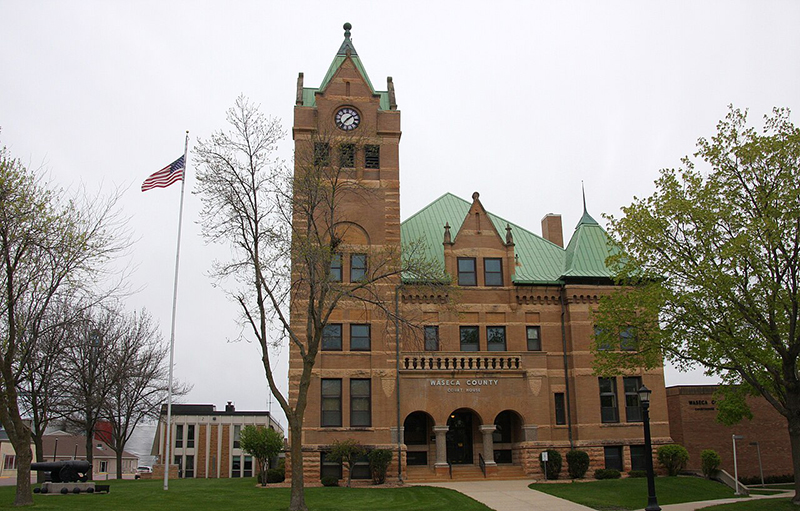
The historic Waseca County Courthouse stands in Waseca, Minnesota, the county seat of Waseca County. Constructed in 1897 in the Richardsonian Romanesque style, the courthouse is listed on the National Register of Historic Places and has long served as the center of county government. (Courtesy Photo)
Stinehart still prefers the quieter side of it.
“We have a couple of neat lakes with some bass in them, a couple neat restaurants to eat at, and we’ve got Barney’s Drive-In where you pull up and order through a microphone,” he said. “It’s quiet and out in the country and I’ve got plenty of room. It’s nice.”
The community has endured hardships too.
In 1967, a devastating tornado tore through Waseca as part of the Iowa–Minnesota tornado outbreak, heavily damaging parts of the city.
But like many Midwestern towns, it rebuilt.
And kept moving forward.
That same blue-collar mentality carries into Stinehart’s everyday life.
During the week, he works in nearby Mankato as a maintenance mechanic for Taylor Corporation, repairing printing equipment before spending weekends at racetracks across the Midwest.
And after all these years, the passion for racing still hasn’t faded.
“I’ll go race anywhere they’ll let me in,” he said with a laugh. “I just like driving my race car.”
Like any longtime racer, Stinehart knows none of it happens alone.
“It takes a village, without a doubt,” he said.
He credits supporters including Ron’s Repair, French’s Repair, Lake Mills Motorsports, Soney’s Auto Body, F2 Trucking, Brew Pub Pizza, Kevko Racing, Extreme Graphics, CBC Construction, Toots Trucking, Well Balanced Speed, KS Engineering, Danube Auto Repair, and Alive and Running of Iowa — a suicide prevention organization he proudly supports.
Skyrocket Chassis has played a particularly important role. Stinehart said working with Kelly at Skyrocket and occasionally helping there part-time has allowed him to learn more about the cars and continue improving his program over the years.
“Everybody that races knows what your family goes through when you go every weekend,” he said. “There have been so many people that have helped with this. The list is endless.”
Then he smiled.
“It’s the fun of going down the road and hanging out with everybody,” he said. “It’s a good time.”