By Ben Deatherage
THREE FORKS, Mont. (Aug. 13, 2026) — Three rivers wind through the broad valleys of southwest Montana, cutting across a landscape framed by mountains and seemingly endless stretches of open country.
Here, the Jefferson, Madison and Gallatin converge to form the Missouri River. The same country has been home to Indigenous peoples for generations, witnessed the passage of Lewis and Clark and Sacagawea, and provided the setting for the legendary escape of fur trapper John Colter. More than two centuries later, the country surrounding Three Forks still carries much of the rugged character of the American West.
For Jordan Tocci, it is simply home.
“The area is so historic with the whole Lewis and Clark history and everything where the rivers come together to make the Missouri,” Tocci said. “It’s cool historically, and you dive deeper in the history of the tribes that lived here and Sacagawea. It’s a really cool part of the world.”
It’s also where another history has been unfolding for three generations.
Tocci’s grandfather Ray returned from service with the Army Air Corps in the Pacific during World War II and eventually found his way behind the wheel of a race car. His son Bruce followed, competing at tracks across Montana for decades.
Then, in 2009, the family’s racing tradition reached a third generation when a 16-year-old Jordan took over his father’s old Street Stock.
What followed has taken Tocci from homebuilt race cars to a Karl Kustoms IMCA Modified, and from familiar Montana dirt tracks to racing trips across the West and Midwest. Today, the driver of the No. 2C is carrying forward a racing tradition that began long before he was born.
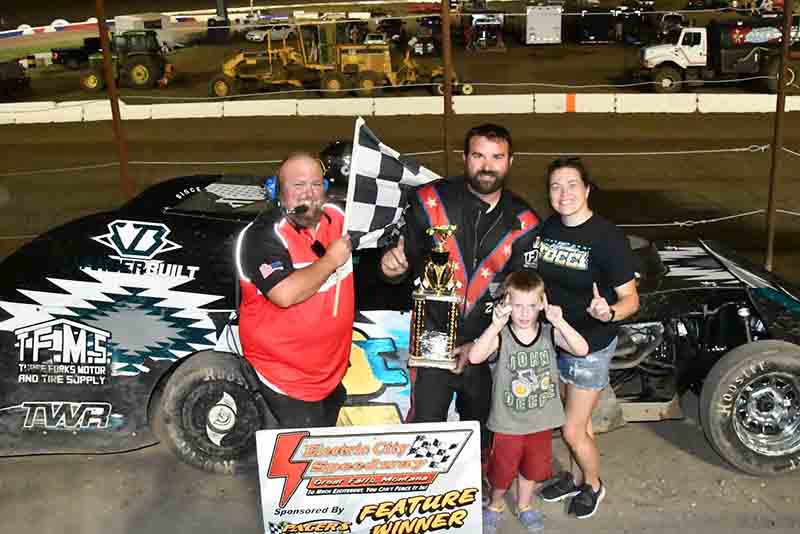
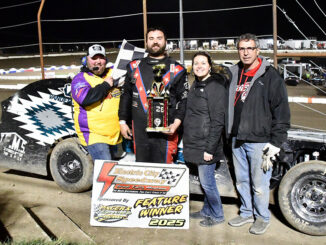
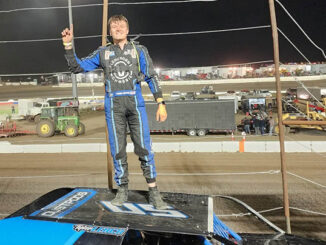
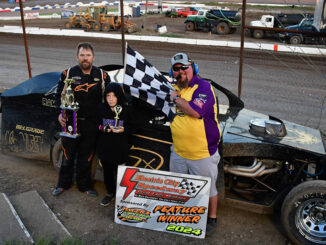
Jordan Tocci celebrates a Karl Kustoms IMCA Modified feature victory at Electric City Speedway on July 18 with family alongside him. Racing has become a three-generation tradition for the Tocci family, with Jordan carrying on a legacy that began with his grandfather. (Photo by MVI Motorsports Photography)
Three Generations of Montana Racing
Ray Tocci didn’t spend as many years behind the wheel as the generations that followed him, but he established the family’s connection to racing after returning home from World War II.
Ray became part of a generation of returning servicemen who found their way into racing after the war.
Years later, Bruce picked up where his father left off.
His introduction to racing came through Harvey Mack, an established racer who lived near the Tocci family and helped Bruce get started during the 1970s.
Bruce competed at tracks across Montana, including Capital City Speedway in Helena, Electric City Speedway in Great Falls and the old Hub of the Valley Speedway in Belgrade. The latter eventually disappeared when the state acquired the property for construction of Interstate 90.
After stepping away during the 1990s, Bruce returned around 2001, the same year Gallatin Speedway opened.
By the end of that decade, however, racing wasn’t giving him the same enjoyment it once had.
His son was coming of age at exactly the right time.
“My dad raced forever, and his dad did it for a while,” Jordan said. “I was coming to age and everything in ’09, and he said he was getting out of it. I didn’t think I would get in a car right away and was fine working for him, but I got my driver’s license in 2009.
“He wasn’t having as much fun behind the wheel, and if he wanted us to keep racing, I would have to do it. So I took over.”
At 16, Tocci climbed into his father’s old Street Stock.
He spent the next several years racing in the division and eventually began building his own cars. When he made the jump to an IMCA Modified in 2018, he did it with another homebuilt chassis.
It wasn’t necessarily the easiest route.
It was the route the family could afford.
“Building your own cars has its pluses and minuses, good and bad, but realistically it was necessary,” Tocci said. “When I got into it in 2009, it wasn’t a great time economically, and so if you wanted to get something cheaper, you built it yourself. That’s the route we went.”
From Homebuilt to Champion
Those early years of building and learning eventually developed into a program capable of winning championships.
Tocci has now captured three consecutive IMCA Modified track titles at Gallatin Speedway, the same facility that opened around the time his father returned to racing.
But home isn’t the only place the No. 2C goes racing.
From 2018 through 2023, Tocci continued campaigning his own cars while venturing away from familiar Montana tracks. He made trips to Arizona, traveled east for Iowa Frostbusters, and has competed during Iowa Speedweek.
Going somewhere new with a car you’ve designed and built yourself can make the notebook awfully thin.
In 2024, Tocci moved into a VanderBuilt Race Cars, giving the family another resource as their racing program expanded.
“We travel around a little bit,” Tocci said. “From ’18 to ’23 I was in my own cars, and in 2024 we switched to the VanderBuilt cars, which made things a little bit easier to travel with someone in your back pocket to steer you in the right direction.
“It makes it a lot less scary versus traveling to a track for the first time that you know nothing about.”
The trips have become part of the experience.
Even the number on Tocci’s Modified tells part of his story.
His last name is pronounced “Toss-E,” something race announcers haven’t always gotten right.
That’s where 2C comes in.
“I have a difficult-to-pronounce last name, and I tell people to put the two and two together,” Tocci said. “It’s super close. When you have the Italian heritage, the two C’s make an S sound. It’s actually Toss-E, but 2C is close.
“I don’t really get mad as long as people try and put some effort into it.”
The car carries another connection to the place Tocci calls home.
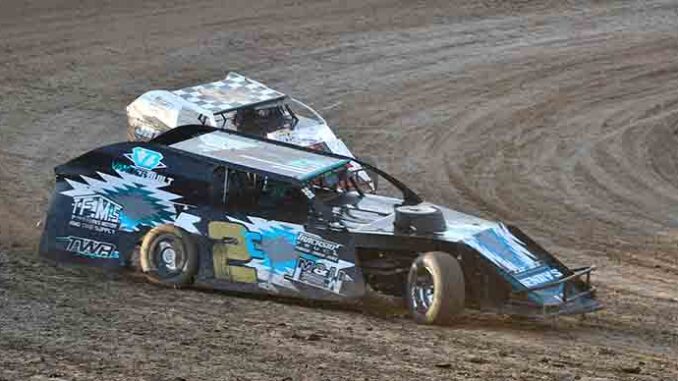
Its distinctive wrap incorporates a beadwork-inspired pattern, an intentional recognition of the Indigenous peoples whose history in the Three Forks area stretches back long before Lewis and Clark arrived.
“We liked the design of the beadwork, of how the natives would have beadwork in the moccasins and clothes, and my wife does that as a hobby,” Tocci said. “A lot of people recognize the importance of the design and that it’s a nod to the natives that were here before us.”
Where Three Rivers Become One
Few racers can claim a hometown surrounded by as much history as Tocci.
The Jefferson, Madison and Gallatin rivers converge near Three Forks to form the Missouri River. When Lewis and Clark reached the confluence on July 28, 1805, they decided none of the three waterways would retain the Missouri name. Instead, they named the rivers for President Thomas Jefferson, Secretary of State James Madison, and Treasury Secretary Albert Gallatin.
Today, the confluences are preserved within Missouri Headwaters State Park, a National Historic Landmark.
The area also has a direct connection to Sacagawea. She was captured near present-day Three Forks in 1800 before eventually returning to the area with Lewis and Clark and the Corps of Discovery. A statue honoring her now stands in Three Forks.
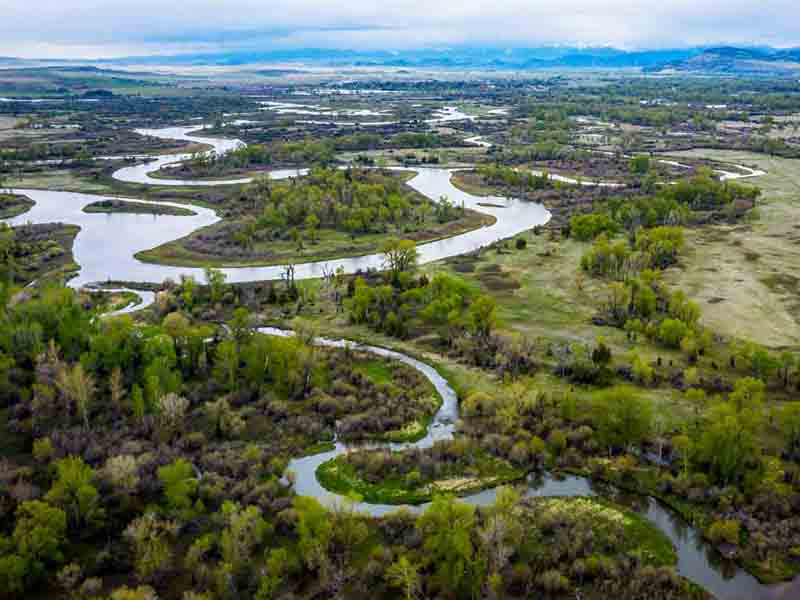
The waterways surrounding Three Forks, Mont., wind through the broad landscape of southwest Montana. The area is home to the headwaters of the Missouri River and serves as the backdrop for Jordan Tocci and his family’s three-generation racing story. (Photo courtesy of FishingBooker.com)
Then there is John Colter.
A former member of the Lewis and Clark Expedition, John Colter returned to the region as a fur trapper. In 1809, according to the traditional account, he and fellow trapper John Potts encountered a large Blackfeet party while traveling by canoe up the Jefferson River. The two were ordered ashore, and while Colter complied, Potts refused. Potts was shot and wounded before returning fire and killing one of the warriors. He was then killed.
Colter was disarmed and stripped. After a council among his captors, he was told to leave before realizing he had been given a head start and was being forced to run for his life.
After several miles, an exhausted Colter had outdistanced most of his pursuers. With only one man still close behind, Colter suddenly stopped and turned to face him. The pursuing warrior stumbled while attempting to throw his spear, allowing Colter to seize the broken weapon and kill him before continuing his escape.
Colter took the man’s blanket and eventually reached the Madison River, where he hid in a beaver lodge while his pursuers searched for him. Emerging under the cover of darkness, he began an extraordinary 11-day journey of roughly 300 miles across the plains, surviving on roots and tree bark before finally reaching Manuel’s Fort on the Bighorn River, exhausted and emaciated, but alive.
The episode became known as Colter’s Run and remains one of the enduring stories of the early American West. More than two centuries later, the legendary escape is still remembered locally with an annual Colter’s Run foot race near Three Forks, allowing modern runners to retrace part of the country associated with his desperate flight — albeit with clothes and running shoes required this time around.
Tocci knows the landscape behind those stories.
“With the groundwater and floods, the actual town is about five miles from where that all actually happened. It’s above ground so it doesn’t get flooded,” he said.
The modern town came much later. Three Forks was founded in 1908 by John Q. Adams of the Milwaukee Land Company and became an important division point on the Milwaukee Road. Early optimism was tempered by economic depression, crop failures and a 1925 earthquake that damaged all of the town’s brick buildings, but the community endured.
Today, Tocci sees it as a place with something to offer year-round.
“There’s four seasons of activity here,” he said. “We’re not just a winter season specialty. Now in the summer it’s floating the rivers and taking it easy at the lakes. In the winter we have the fun ski resorts.”
Nearby Bozeman provides restaurants, entertainment and other amenities, while Yellowstone National Park is roughly an hour away.
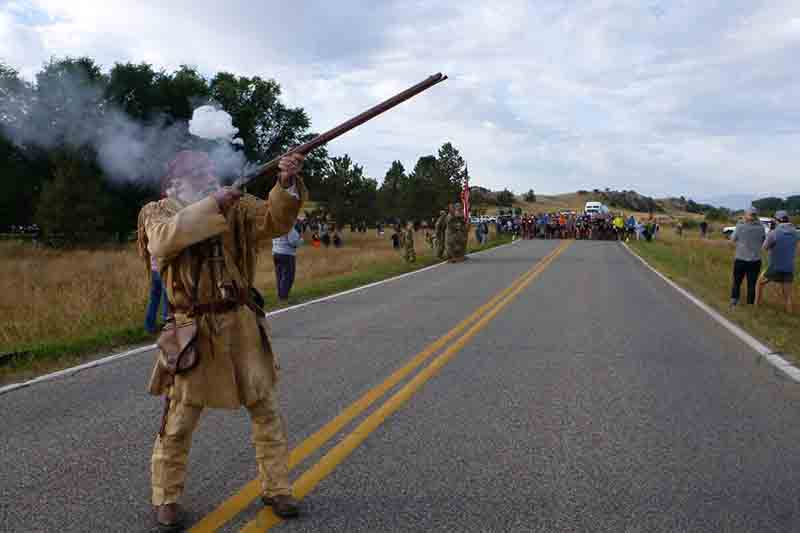
A reenactor fires a rifle as runners prepare to begin the annual Colter’s Run near Three Forks, Mont. The event commemorates legendary frontiersman John Colter’s escape from pursuing Blackfeet in 1809, although modern participants make the journey with the benefit of clothes and shoes. (Photo courtesy of the Three Forks Voice)
Carrying It Forward
The same hands-on approach that helped Tocci build race cars carries into his life away from the speedway.
He runs the maintenance department at an open-pit sand and gravel operation, helping oversee the process of extracting and processing material used for roads, sewer systems and home foundations.
The work begins by removing and preserving the topsoil before gravel is extracted and processed into usable material. Once an area has been mined, the land is reclaimed and the topsoil replaced.
His wife, also named Jordan, works as a livestock specialist for a company based in Des Moines.
Racing, though, remains a family commitment.
Tocci is quick to acknowledge what his wife and father sacrifice during a Montana racing season that stretches from May through September.
“I want to thank my wife and my dad,” he said. “They give up a lot of hours throughout the week to me from May to September, and they go above and beyond.”
He also credits Trackside Truck, the family’s local business selling parts and fuel at the racetrack, along with Three Forks Motor & Tire Supply, Snap-on/Wilder Performance in Cody, Wyo., Plaza Bar & Casino, Sunoco Race Fuels, Doc J Designs and Henry’s Headers & Exhaust for their support.
More than half a century after Ray Tocci returned from the Pacific and found his way to a racetrack, the family is still there.
Ray started it.
Bruce carried it forward.
And when Bruce was ready to climb out of the driver’s seat, Jordan took the wheel.
Now the No. 2C travels far beyond Montana, but eventually it always comes home to Three Forks — to Gallatin Speedway, to the mountains and valleys, and to the place where three rivers become one.
Three generations from Three Forks, bound together by one racing tradition.