By Ben Deatherage
MADISON, Va. (Sept. 28, 2026) — French Grimes once compared himself to Johnny Appleseed.
Instead of carrying a sack filled with apple seeds, Grimes believed his contained something else.
RaceSaver.
“I said I’m Johnny Appleseed,” Grimes explained during a 2013 interview. “I’ve got a sack of seeds for RaceSaver, and I go around the country. I poke them in a hole where I think it’ll grow, and then we find somebody who’s dedicated to make sure we water it and make it grow.”
For nearly three decades, that is essentially what he did.
Grimes helped plant those seeds in Virginia. They took root in Pennsylvania, Texas, New Jersey, the Carolinas and eventually across much of the country.
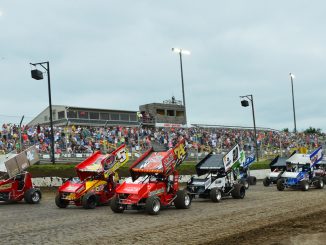
What began as an effort to make Sprint Car racing affordable enough for ordinary working racers grew into a national movement and eventually became intertwined with IMCA racing across the country.
Grimes, the founder and driving force behind RaceSaver, died Sept. 13 at the University of Virginia Hospital surrounded by his family. He was 83.
He left behind considerably more than a set of Sprint Car rules.
He left behind an avenue into the sport for hundreds of racers who otherwise might never have been able to afford one.
“This is a sad day for everybody involved with RaceSaver racing,” River Valley Builders PA Sprint Series co-director Rod Ort said following Grimes’ passing. “French made affordable Sprint Car racing a national reality, and countless teams exist today because of his foresight and dedication. He also was a wise counselor and good friend.”
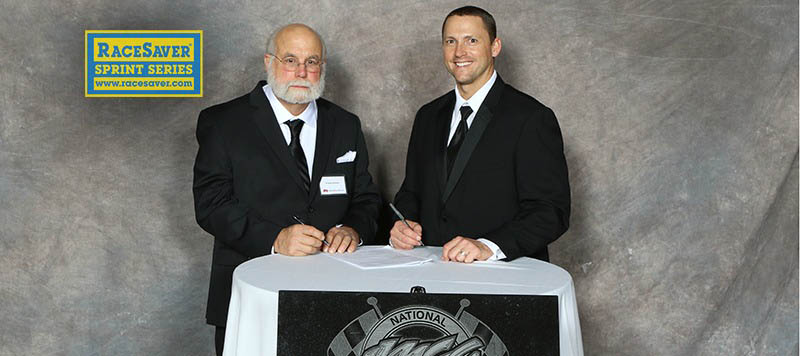
RaceSaver founder French Grimes, left, and IMCA President Brett Root formalize the expanded partnership between RaceSaver and IMCA in 2014. Under the agreement, IMCA assumed sanctioning and promotional responsibilities while Grimes continued overseeing the technical aspects of the RaceSaver program. (Courtesy Photo)
A Racer Before RaceSaver
French Hunter Grimes was born July 1, 1943, the son of French Pierce and Alice Lucy Teats Grimes.
Long before RaceSaver existed, Grimes had already developed the mechanical ability that would eventually become an important part of his life’s work.
He doubled his credit hours and graduated early from high school in Washington, D.C., before beginning a career as a steam pipe fitter there during the late 1960s. He later became head mechanic at Culpeper Stone Quarry.
Grimes retired at just 39 and became a self-employed mechanic.
His ingenuity extended beyond race cars. He created and patented an articulated hold-down clamp for distributors, magnetos and twin mags.
But motorsports had captured his attention much earlier.
Jim Haines of the Virginia Sprint Series first met Grimes in 1983, but Grimes’ involvement in racing stretched back farther than that.
“French had been a go-kart kid back in the days of Marlboro Raceway,” Haines said of the Maryland facility that closed in the early 1970s.
Marlboro wasn’t a small, purpose-built kart track. It was a full-sized oval with a road course incorporated into the facility, using part of the oval as part of the road course. According to Haines, the karts raced on the full-sized facility rather than on a separate kart track.
The karts of that era weren’t the four-stroke machines commonly associated with entry-level racing today. They were two-stroke machines with considerably greater power-to-weight ratios, and Haines said moving from them into Sprint Cars was a natural progression for many racers.
By the late 1970s, Grimes had made that progression himself and began racing Sprint Cars.
Finding somewhere nearby to race one was considerably more difficult.
The Virginia, Maryland and Pennsylvania region had once hosted a class known as the 30-by-90s, named for cars approximately 30 inches wide with 90-inch wheelbases. Haines described them as machines that looked more like Supermodifieds before eventually evolving toward Sprint Cars.
By the time Haines and Grimes were racing, however, Sprint Car competition had largely migrated north to Pennsylvania.
“French was running when he could in Pennsylvania,” Haines said. “The closest place for us Sprint Car guys at that time was Hagerstown Speedway in Maryland every other Sunday. Other than that, if you wanted to go race Sprint Cars, you had to go to Lincoln, Williams Grove or Selinsgrove or places like that, because there were no Sprint Cars in Virginia at that time.”
Grimes raced when and where he could.
The problem was that traditional Sprint Car racing was becoming increasingly difficult for someone without a substantial racing budget to afford.
Eventually, Grimes and several others decided to do something about it.
Building RaceSaver
The idea that became RaceSaver didn’t belong to one person alone.
Haines remembers four people at the foundation of the program: Grimes, Mike Williams, Bill Rice, and Ed Schubert.
They had seen 305 cubic-inch Sprint Cars competing elsewhere, but some of the cost-saving rules being used didn’t make sense to them.
Requirements such as steel rear axles and manual steering might have reduced expenses in theory, but they could also force racers to search for decades-old components and hope those parts remained safe and usable.
Grimes and the others believed there was another way.
“The RaceSaver thing came about at the end of 1997,” Haines said.
The objective wasn’t simply to create a slower or cheaper Sprint Car.
It was to develop a rules package that controlled engine costs, remained enforceable and still produced the performance racers expected from a Sprint Car.
Brodix developed a specification cylinder head that could be kept closely matched from engine to engine. The 305 cubic-inch engine became central to a package intended to last rather than force competitors into continually replacing expensive engines in search of more horsepower.
“The main goal was to make an engine rule to contain cost and still give good performance,” Haines said. “It would last, and you wouldn’t have to buy a new one every year.”
There was another philosophy behind the rules that Haines believes has been equally important.
“The biggest thing about these rules French and everyone came up with is there’s no ‘but’ in the rules,” Haines said. “So many times you hear someone say, ‘I like this rule, but …’
“The rules have been the rules since 1997, and we haven’t had to change much since then, though we’ve had to update or give a clarification for a thing or two that wasn’t foreseen.”
Grimes also emphasized consistent enforcement.
The combination was designed to prevent the same cycle that had made other forms of Sprint Car racing increasingly expensive: competitors spending more to gain an advantage, rules changing in response and costs escalating again.
For Grimes, the mission could be reduced to something much simpler.
Sprint Car racing needed to remain attainable.
“Sprint Car racing was in trouble because of runaway costs,” Grimes said in 2013.
RaceSaver was his answer.
Planting Seeds Across the Country
The Virginia Sprint Series became an early home for the concept, while the Pennsylvania Sprint Series was among the first regional organizations outside Virginia to adopt the RaceSaver rules.
Because PASS and VSS frequently co-sanctioned events, Grimes became a familiar figure to racers in Pennsylvania as well as Virginia.
Then the idea began spreading considerably farther.
Haines remembers Ken McDaniel of Avenger Chassis adopting the RaceSaver concept and helping revitalize Sprint Car racing in West Texas.
Pennsylvania developed PASS with Ort among those involved. RaceSaver racing expanded into New Jersey through a Mid-Atlantic organization, into western Pennsylvania and into the Carolinas.
The reason, Haines believes, was that other racing communities were encountering the same problem Grimes had tried to solve.
“People saw and realized that stuff in their area was dying, and they began to wonder what they could do to reintroduce Sprint Car racing,” Haines said.
RaceSaver offered an answer.
“The RaceSaver idea was to make it as inexpensive as possible,” Haines said. “They’re Sprint Cars. They race just like any Sprint Car, and that’s what they are, except a track can afford it and a guy can run one and have a job and afford one.”
Equally important was uniformity.
A RaceSaver competitor wasn’t supposed to need one engine package in Virginia and another after towing halfway across the country.
“RaceSaver was a deal from day one where you can take your car in Virginia and go to Dallas, or go from Dallas to show up at Eagle, and if you have a legal car and driver, you can race,” Haines said.
Grimes didn’t merely write the rules and watch everyone else use them.
He raced under them himself.
Haines said RaceSaver allowed his longtime friend to compete more often than Grimes had ever been able to afford while racing 410 Sprint Cars.
“He won his fair share,” Haines said.
Grimes continued racing until only a few years before his death.
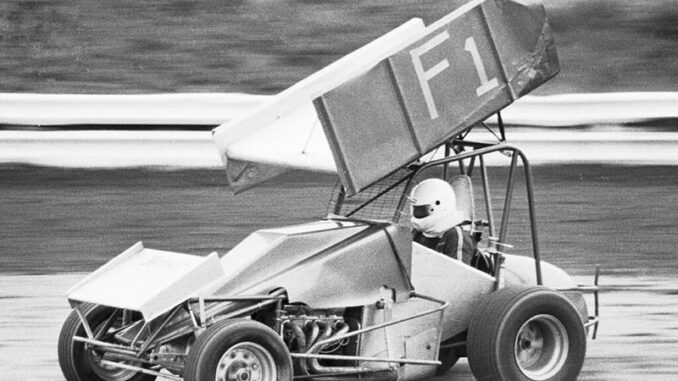
Even the F1 painted on his race car carried the kind of story that followed a lifetime spent racing.
Haines remembers versions of the tale involving Grimes arriving at a track and discovering that either No. 1 or No. 11 was already taken.
Rather than make the situation complicated, Grimes found an easier solution.
Tape.
“He said it was easier to make numbers out of tape,” Haines recalled with a laugh.
F1 stuck.
RaceSaver Meets IMCA
One of the most important steps in RaceSaver’s growth came in 2011.
Roger Hadan was promoting Eagle Raceway in Nebraska, where his 360 Sprint Car division was struggling as costs climbed and car counts declined.
Hadan began looking for another approach.
“Three years ago, I had a weekly Sprint Car class at Eagle Raceway that was struggling with its car count due to rising costs,” Hadan recalled in a 2015. “After having 50 different sets of Sprint Car rules spread out across my living room floor, trying to find rules that were enforceable, I discovered RaceSaver. So that is the direction we took.”
Hadan contacted Grimes about another possibility.
IMCA already sanctioned Sprint Cars.
Haines remembers the conversation clearly.
“Roger Hadan at Eagle Raceway had contacted us because his 360s were dying, and he asked French, ‘What would you think about joining IMCA? They have a Sprint Car division,'” Haines said.
The philosophies lined up.
“French called me, and I told him that their ideas are the same as ours, and they’re the oldest sanctioning body in the country and they’re the biggest,” Haines said.
The conversations ultimately led to the original partnership between IMCA and RaceSaver, which was announced in February 2012.
For RaceSaver, the relationship provided an established national structure for points, administration and oversight.
“We all said we would love to join them,” Haines said. “They gave us a structure of points and oversight of everything where we didn’t have to call every week for something.”
The relationship took another major step in 2014.
Under a new long-term agreement, Grimes allowed IMCA use of the RaceSaver rules for weekly racing, regional series and special events. IMCA assumed responsibility for sanctioning and promoting what became known as RaceSaver, a division of IMCA.
Grimes retained control of the technical side of the program, including rules, record keeping, cylinder heads, engine certification, engine sealing and tech officials.
By then, what had started in Virginia had become considerably larger.
At the time of the 2014 agreement, Grimes said RaceSaver represented more than 1,000 Sprint Cars in 17 states.
The partnership helped open additional doors.
RaceSaver Sprint Cars expanded at Eagle and elsewhere in Nebraska, into Minnesota, South Dakota, North Dakota, Kansas, Ohio, Oklahoma, Indiana and California, among other states. In 2026, Montana became part of that growing footprint as well.
The seeds Grimes had spent years planting were beginning to grow.
Eventually, Haines said, participation “exploded into hundreds and hundreds of competitors.”
One Dollar
By 2015, the program Grimes and others had started nearly two decades earlier was firmly established.
Hadan’s experience at Eagle demonstrated what the concept could do.
Within three years of adopting RaceSaver, a Sprint Car class that had been struggling was regularly attracting fields of 30 or more cars.
Then Grimes made another decision that illustrated what RaceSaver had always meant to him.
On Dec. 10, 2015, at the Performance Racing Industry Trade Show, Grimes sold RaceSaver to Hadan.
The price was $1.
It was never simply an asset Grimes had built to sell.
It was an idea he wanted to survive.
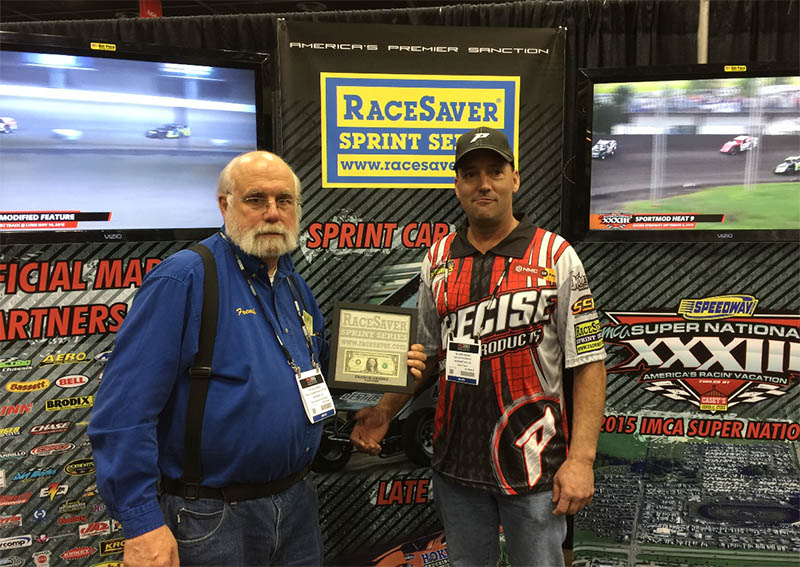
RaceSaver founder French Grimes, left, presents Roger Hadan with RaceSaver at the Performance Racing Industry Trade Show in December 2015. Grimes sold RaceSaver to Hadan for just $1, helping ensure the affordable Sprint Car program he helped create would continue into the future. (Courtesy Photo)
A way for someone with a regular job, a race car in the garage and a desire to compete to call themselves a Sprint Car racer.
That remained at the center of RaceSaver long after it expanded beyond Virginia.
“We are all going to miss French Grimes,” Ort said, “and we send out condolences to his family and many friends.”
Grimes is survived by his wife, Virginia Karen Grimes; daughters Shannon Welch and Nancy Mitchell; son French C. Grimes; stepson Nathan Lee Harbin; 10 grandchildren; and three great-grandchildren.
Nearly three decades after RaceSaver began, racers across the country continue competing under a concept built around a simple belief Grimes carried for years:
A person shouldn’t have to be wealthy to race a Sprint Car.