By Ben Deatherage
WEST MEMPHIS, Ark. (Apr. 13, 2026) — Just across the Mississippi River from Memphis, where freight trucks rumble through one of the busiest corridors in America and the Delta air hangs heavy over rich, dark soil, sits West Memphis, Arkansas—a place shaped by movement, grit, and history.
It’s a region where river crossings, rail lines, and highways all converge. Where Saturday nights still belong to dirt tracks carved into gumbo clay.
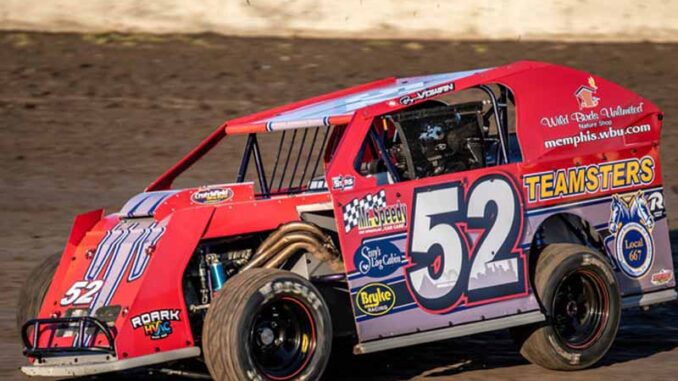
For Bryce Vowan, this isn’t just where the driver of the no. 52 Stealth Racing IMCA Mod Lite lives.
It’s who he is.
A Region Built on Movement and Music
West Memphis sits on the western bank of the Mississippi River, directly across from Memphis, Tennessee—a pairing shaped by geography, commerce, and culture.
Long before it became a modern transportation hub, the region was defined by the river itself. In 1541, Spanish explorer Hernando de Soto crossed the Mississippi near present-day Crittenden County, encountering one of the most densely populated regions he had seen on his expedition. Centuries later, early settlements like Hopefield would rise along the riverbanks, only to be destroyed during the Civil War and eventually lost to flooding, leaving behind little more than scattered traces of what once stood.
By the early 20th century, West Memphis began to take shape as a city, fueled by lumber operations, railroads, and the construction of major highways like U.S. 70 and U.S. 61. Rapid growth in the decades that followed earned it the nickname “Wonder City,” while modern infrastructure—including Interstate 40 and the Hernando de Soto Bridge—cemented its role as a key crossing point and transportation hub in the Mid-South.
Across the river, Memphis developed into one of the most culturally influential cities in America—known as the “Home of the Blues,” the “Birthplace of Rock ‘n’ Roll,” and often called the barbecue capital of the world. Landmarks like the Memphis Pyramid —sharing its namesake with the ancient Egyptian city—now house a massive sport goods shop and rise along the skyline as reminders of the city’s evolving identity. Together, the two cities remain closely connected, sharing not just geography, but history, culture—and a deep-rooted connection to racing.
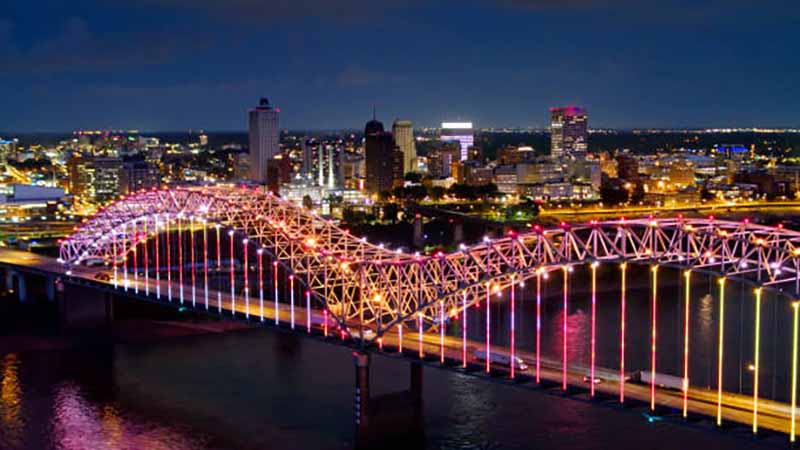
The Hernando de Soto Bridge spans the Mississippi River between Memphis, Tenn., and West Memphis, Ark., serving as a vital link in one of the nation’s busiest transportation corridors. (Photo by iStockPhotos.com)
Raised in Racing
Vowan didn’t discover racing—it was already around him.
“I grew up around a racing family,” he said. “My stepfather raced Sprint Cars for a really long time. I was usually the first one in the grandstands when they opened the gate because minors were not allowed in the pits.”
That stepfather, Mike Campbell, built the foundation beginning in 1978, after attending races for several years with his own father.
“I spent a lot of nights in the shop learning how to work on the car,” Vowan said. “He would show me what to do.”
Then came the moment that made it real.
“One time I came home and a UPS truck had dropped off a big box,” he said. “There was a seat my size and I knew then it was my turn.”
More than a decade ago, Vowan found his place in Mod Lites—but not without starting over.
“I had to learn how to drive all over again,” he said. “These cars are very unique.”
With Sprint Car racing becoming financially out of reach, Mod Lites became the path forward.
“They’re faster than they look, and they don’t take up as much space in the shop.”
About eight years ago, he committed fully—buying his own car and learning every detail of how to make it competitive.
The results followed.
Now, he’s the three-time defending Mod Lites of Arkansas champion.
Even his car number reflects his roots.
“My stepfather was always no. 2, and I loved the number 5,” he said.
So he combined them.
“That’s how 52 came to be.”
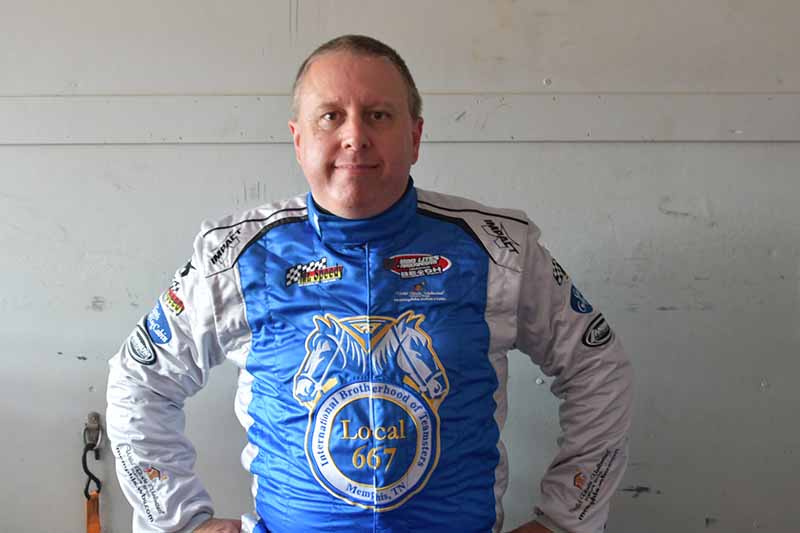
Bryce Vowan of West Memphis, Ark., shows off his new firesuit for the 2026 season, representing Teamsters Local 667 and his supporting partners. (Courtesy Photo)
More Than Just a Driver
Vowan’s impact extends far beyond the cockpit.
As president of the Mod Lites of Arkansas series, he’s helped reshape the class and expand its reach.
“My vision was to get the class more exposure, take these cars to tracks that had never seen them, and help grow it,” he said.
That meant traveling across the state, bringing the class to new venues, and growing interest from both fans and drivers.
“It puts everyone on a level playing field,” he said. “No one has an advantage.”
What started as a short-term effort turned into a long-term role.
“I didn’t think I’d still be doing it eight years later.”
At Crowley Ridge Raceway, Vowan helped create something bigger than racing.
Racing For The Paws has become a signature event—bringing together racers, fans, and the community to support the Northeast Arkansas Humane Society.
“I wanted to do something more than just racing,” he said.
Fans and competitors bring donations—pet food, supplies, and more—turning race day into a community effort.
“It’s turned into a big success,” Vowan said. “It makes me feel even better knowing that we as Mod Lite racers makes a difference.”
The event returns for its fourth year in 2026.
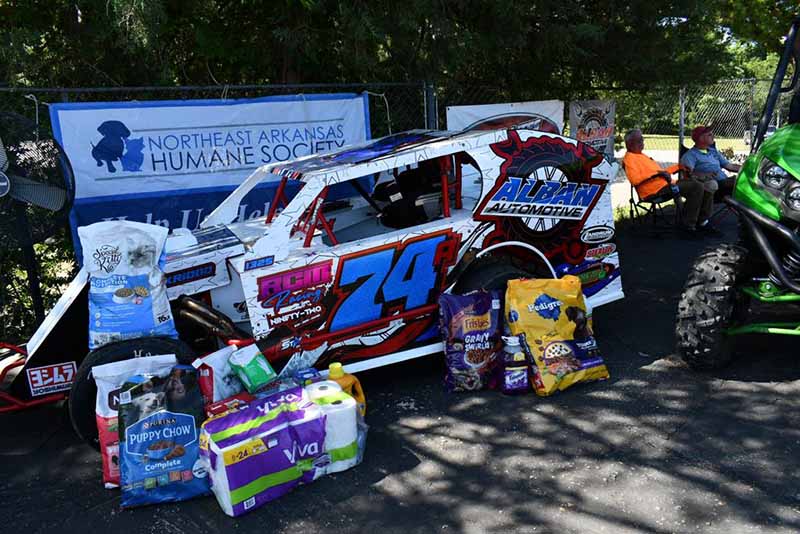
Donations of pet food, supplies, and essentials pile up during the Racing For The Paws event at Crowley Ridge Raceway, an initiative led by Bryce Vowan to benefit the Northeast Arkansas Humane Society. (Courtesy Photo)
Ending the Season With a Statement
Each season builds toward the MLA Nationals at Riverside.
“We always want to finish with a bang,” Vowan said.
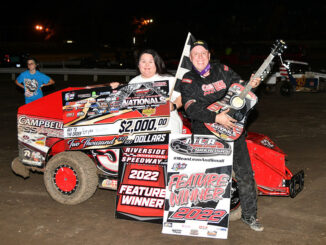
Set for Sept. 19, the event pays $2,000 to win and awards a custom Fender guitar trophy—one of the most unique prizes in dirt track racing. That event once nicknamed the “Mini Mod Challenge” has since turned into a IMCA national event with drivers from across the region make the trip, turning it into a showcase for the class.
Tracks across Arkansas offer unique challenges, none more so than Riverside International Speedway.
The gumbo clay surface—dark, moisture-rich, and constantly evolving—creates conditions unlike anywhere else.
“You can actually see the moisture come up through the ground,” Vowan said. “It gets tackier as the night goes on.”
The People Behind It All
Outside of racing, Vowan has spent 25 years driving for UPS, meaning he’s behind the wheel just about all the time—and even then, racing never really stops.
“I don’t know what life is really like outside of racing,” he said with a laugh.
Between races, he spends time with his wife Amy, family, and their two dogs, while already planning for the next season.
Vowan is quick to recognize those who make everything possible.
“I’m very fortunate to have really great people behind me,” he said.
That support starts with his stepfather, Mike Campbell, who “practically lives in the race shop 24/7” working to improve the car.
“I’m proud to be backed by the hardworking men and women of International Brotherhood of Teamsters Local 667 in Memphis,” Vowan said, where he serves as chief shop steward at his UPS hub.
Additional support comes from Mr. Speedy Car Care, Wild Birds Unlimited Nature Shop, Sissy’s Log Cabin Jewelry Store, Tire Bloomers, and Roark Heating and Air.
He also credits the dedicated officials of the Mod Lites of Arkansas series, including race director Wayne Norman, Dwayne and Karen Reed, Robert Fortner, and lead tech official Joe Harris.
“When it’s race day, they’re in charge,” he said. “I just make sure everything else is ready.”
From a kid opening a box with a racing seat inside to a three-time series champion to a leader helping grow an entire division.
Bryce Vowan didn’t just find his place in racing.
He’s helping build its future.
And in the Natural State of Arkansas, that future is still gaining speed.