By Ben Deatherage
WEYBURN, Sask. (Aug. 12, 2026) — The airplane lifts away, its engine growing quieter until eventually there is nothing left but the water, the wilderness and silence.
Brendon LaBatte stands on a dock hundreds of miles into northern Saskatchewan. There are no roads leading back to civilization. No help waiting around the corner. For someone who spent 14 seasons battling 300-pound linemen in the Canadian Football League and now wrestles a homebuilt Sunoco IMCA Stock Car around dirt tracks on both sides of the border, even this can get the adrenaline flowing.
“It’s such a different feeling when that plane takes off and you’re left standing there on the dock,” LaBatte said. “I’ve been out there all alone and you think, ‘Oh man, I’m really doing this.’ It’s always a rush and an adventure.”
Competition and adventure have been constants throughout LaBatte’s life.
The Weyburn native went from racing as a teenager to becoming the sixth overall selection in the 2008 CFL Draft. He spent four seasons with the Winnipeg Blue Bombers before returning home to Saskatchewan, where he became one of the CFL’s premier offensive linemen with the Roughriders. His football résumé includes six CFL All-Star selections, nine division All-Star honors, the 2013 CFL Most Outstanding Offensive Lineman Award and, most memorably, a Grey Cup championship won with Saskatchewan in his home province.
But before there was professional football, there was racing.
And after football ended, racing was still there.
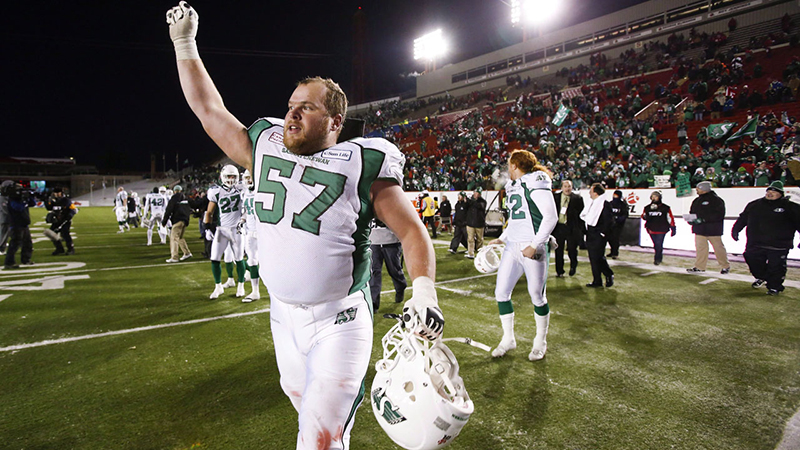
Brendon LaBatte celebrates after the Saskatchewan Roughriders won the CFL West Final in Calgary, Alta., on Nov. 17, 2013. The victory sent Saskatchewan to the Grey Cup in Regina, where LaBatte and the Roughriders captured the championship one week later. (Photo by Jeff McIntosh/The Canadian Press)
A Family Built Around Racing
LaBatte’s story behind the wheel began long before anyone knew where football would take him.
His father, Dale, raced throughout Saskatchewan and Alberta during the 1970s, traveling with two cars and a pitman before eventually stepping away after starting a family. Years later, the LaBattes began attending races at Estevan, exposing Brendon to the sport that had once consumed so much of his father’s time.
By the time Brendon began racing himself, Dale’s days behind the wheel were already over.
Even the family’s No. 5 dates back to Dale’s earliest days in racing.
Around 1973, while Dale was in Grade 12, he and three friends pooled their money to go racing together. They wanted No. 4 for their car, but discovered it was already taken.
They settled on No. 5 instead.
The number stuck with Dale and, decades later, Brendon carried it into his own racing career.
“I started racing a Hobby Stock when I was 15 years old, so I guess I’ve been doing this for 25 years now,” he said.
By 2006, LaBatte had moved into Modifieds and spent the next several years traveling extensively, occasionally venturing as far south as Nebraska. But as his football career took off, keeping up with the demands of a Modified became increasingly difficult.
The Stock Car offered an answer.
LaBatte moved into the division around 2011 and eventually cycled through several chassis before acquiring Jay Schmitt’s former car in 2017. Then the family decided to try something entirely different.
They would build their own.
In 2024, Brendon’s brother, Sterling, began constructing the family’s homebuilt Stock Car chassis. Sterling handles the fabrication, bending, fitting, and welding while Brendon contributes ideas and works with the shocks and suspension. Dale takes care of the engines.
“We’re constantly trying stuff,” LaBatte said. “It’s not like we’ve got one setup that we go back to. We get in the area and we try stuff, whether it’s a shock or a gear. When you’re in your own car, that’s what you do. You try and find speed with the ideas that you come up with.
“That’s the fun part and the challenge we all enjoy.”
That work was rewarded in July.
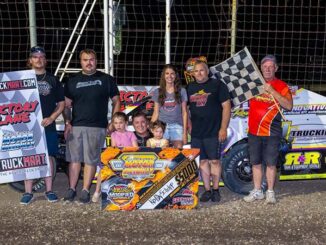
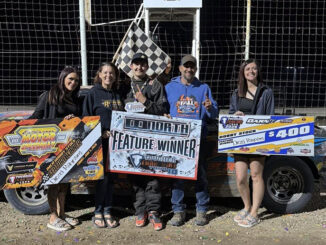
LaBatte captured his second career Dakota Classic Modified Tour Stock Car victory July 10 at Jamestown Speedway, making a last-lap move to win with equipment his family had built themselves. His first tour triumph had come three years earlier at Dacotah Speedway.
“That first tour win was so cool because the track at Mandan was so technical to drive,” he said. “But this last one, to do it on the last lap and do it all in homebuilt stuff, was really gratifying and probably the biggest one.”
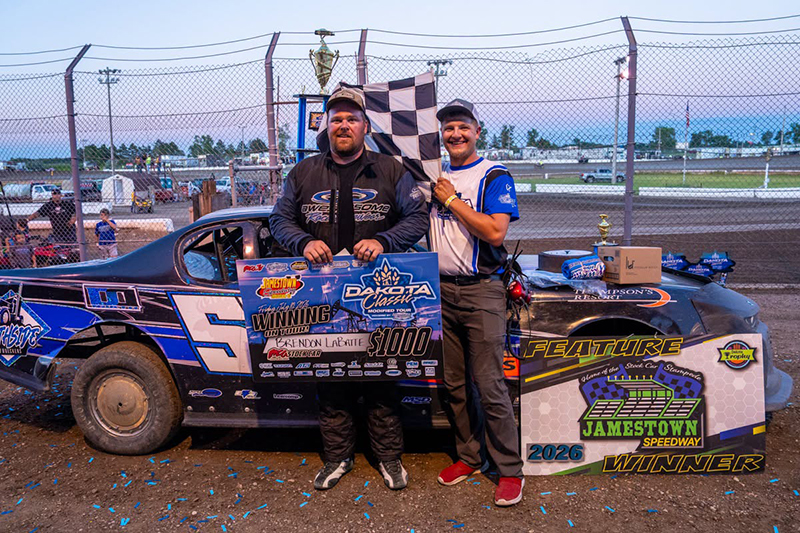
Brendon LaBatte of Weyburn, Saskatchewan, celebrates after scoring his second career Dakota Classic Tour victory in the Sunoco IMCA Stock Cars on July 10, 2026 at Jamestown Speedway. (Photo by Byron Fichter Fotography)
From No. 5 to No. 57
Brendon began his career carrying his father’s No. 5 before eventually incorporating the number that became synonymous with his professional football career.
LaBatte wore No. 51 during his collegiate career with the University of Regina Rams. When the Winnipeg Blue Bombers selected him sixth overall in the 2008 CFL Draft, his professional number became 57.
It stuck.
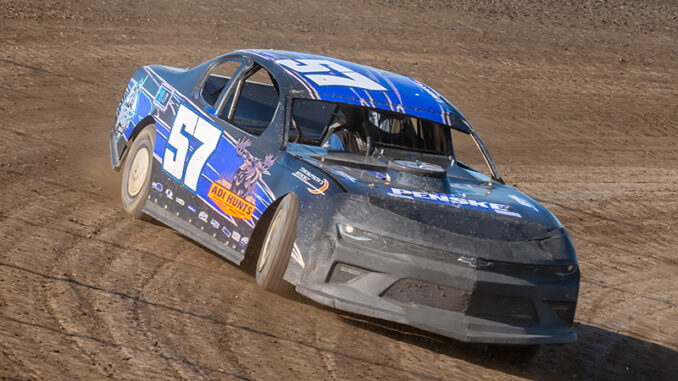
Today, 57B adorns the side of his Stock Car, connecting two very different chapters of LaBatte’s competitive life.
Football took him a long way from those early nights at the racetrack. After establishing himself with Winnipeg, he returned to his home province as a free agent and joined the Saskatchewan Roughriders in 2012.
One year later came the moment Saskatchewan football fans dream about.
The Roughriders won the 2013 Grey Cup in Regina.
“It was super special to be a free agent and come back home to play for the Roughriders,” LaBatte said. “We were able to win the Grey Cup at home, and it was a great time to be a football fan in the province.”
LaBatte sees more similarities between football and racing than might initially meet the eye.
Long before he reached the CFL, racing taught him to concentrate on what he could control rather than worrying about the equipment or resources everyone else possessed.
“I think the mental toughness that comes with racing helped me a lot in football,” he said. “There were a lot of times I could think back to just me and my dad showing up on an open trailer and going out there to compete and not worrying about what anyone else was doing or what they had.
“You just worry about your own program and know that what you do during the week is going to dictate what results you get on the weekend.”
The lesson translated perfectly.
“Football is the same exact thing,” LaBatte said. “There’s a lot of things I picked up, whether it was how to become a competitor or how to repair things, but racing helped me tremendously in football.”
Into the Saskatchewan Wilderness
Life after professional football has taken LaBatte in another direction.
Since 2019, he has worked with Adventure Destinations International, better known as ADI Hunts, an outfitting operation offering hunting and fishing experiences throughout remote northern Saskatchewan.
His role has steadily expanded.
LaBatte now works year-round in sales while managing five do-it-yourself outpost camps, coordinating maintenance, upgrades and flights. During the offseason, the job can also take him on the road to trade shows.
Some of the destinations are roughly 650 miles north of Williston, N.D., near the Arctic Circle, where airplanes rather than highways provide access to remote lakes and camps.
Guests can stay at a home base with accommodations and guides, fly into isolated lakes with their own food and equipment or experience high-end, all-inclusive fishing camps.
For LaBatte, the remoteness is part of the appeal.
“To get off the grid and reconnect to nature, recharge and come back, there’s nothing like it,” he said. “I’m passionate about it. There’s a lot of good things that come out of it, and it makes you feel like you’re going back in time.”
But the wilderness demands respect.
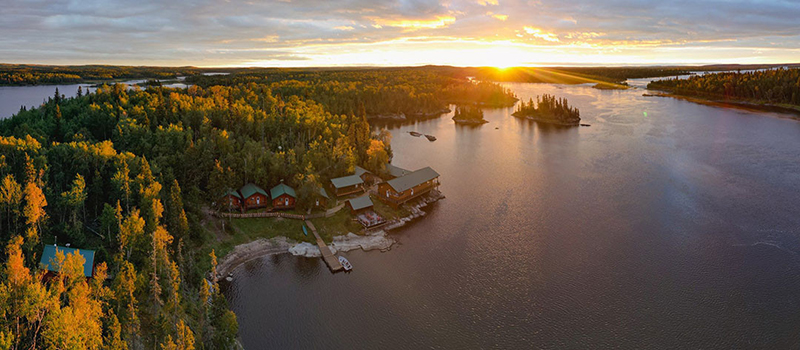
Twin Falls Lodge sits among the lakes and forests of northern Saskatchewan, where Brendon LaBatte’s work with Adventure Destinations International takes him far from the racetrack and deep into the Canadian wilderness. LaBatte works year-round with ADI Hunts and helps manage the company’s remote outpost camps and fishing destinations. (Photo by AdventureDestinations.ca)
When an airplane leaves, there isn’t necessarily someone nearby if something goes wrong. Equipment failures, injuries, and encounters with curious or territorial wildlife all require caution.
The same company that takes LaBatte deep into the Canadian wilderness has also become an important part of his racing program. ADI Hunts serves as the primary sponsor of the No. 57B, with LaBatte helping introduce the company to the reach of IMCA racing in the United States.
“It’s great that the company wants to come to the racetrack and spend their advertising dollars at the racetrack,” he said. “When I first started mentioning it to them, it seemed so foreign, but they’ve seen the attention and following of IMCA racing in the U.S. It’s become a place worth investing their dollars, and it’s been great having them on board with us.”
Southside Auto Wreckers in Weyburn has supported LaBatte since the beginning, while the Adventure Destinations group, Twin Falls and Thompson resorts, Penske Racing Shocks and Demon Decals North have also helped keep the family operation competing.
Away from work and racing, LaBatte enjoys camping, golfing, spending time at the lake and ice fishing when he isn’t busy at the rink coaching his son’s hockey team.
Home in Weyburn
Through everything, home remains Weyburn.
The southeastern Saskatchewan community grew from the arrival of the Canadian Pacific Railway in 1892 and the Soo Line the following year. A post office opened in 1895, Weyburn became a village in 1900 and a town three years later before officially becoming a city in 1913. Railroads helped establish the community, while agriculture and the energy industry remain important to the region today.
Weyburn also became home to the Souris Valley Mental Health Hospital, which opened in 1921. At the time, the massive facility was the largest building in the British Commonwealth and was considered at the forefront of experimental mental health treatment. At its peak, approximately 2,500 patients lived there. The hospital eventually closed as a health care facility, and the building was demolished in 2009.
“We used to own a bar and the Tim Hortons in town,” LaBatte said. “There’s lots of oil, the energy sector is big, and there are lots of farms around. It’s a relatively peaceful place.”
For travelers heading north from Estevan, Weyburn is the first city they reach, surrounded by the farms and energy industry that have helped shape southeastern Saskatchewan.
It’s also where a life that has taken LaBatte from an open race car trailer to professional football stadiums, a Grey Cup championship and the remote reaches of northern Saskatchewan continues to come back to its roots.
These days, some of his biggest victories aren’t earned beneath stadium lights.
They’re earned with his father building engines, his brother welding together a race car they designed themselves, and the No. 57B finding its way to the front.
More than half a century after Dale and three high school friends settled for No. 5 because the number they wanted was already taken, racing remains a LaBatte family endeavor.
The number may have changed.
The family connection hasn’t.