
By Ben Deatherage
MONTE VISTA, Colo. (Apr. 21, 2026) — Out in southern Colorado, where the land stretches wide beneath towering mountain ranges and the air sits thin at more than 7,500 feet above sea level, racing isn’t just something you do—it’s something you carry with you.
The San Luis Valley is one of the most unique places in the country—an expansive, high-altitude basin carved by the Rio Grande and surrounded by peaks. Agriculture drives life here, from cattle to potatoes to barley fields, and the distances between towns are measured in miles, not minutes.
Monte Vista sits at the heart of it all, a town established in 1884 along the railroad, its Spanish name meaning simply “mountain view.”
It’s here where Christina and Matt Ratzlaff have built both a life—and a race team.
Two Drivers, One Team
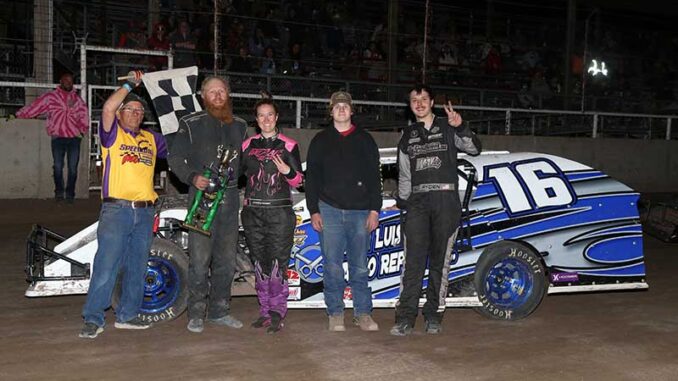
On any given night, the Ratzlaffs roll into the pit area as a two-car operation in the Karl Kustoms IMCA Modifieds with Christina in the No. 15 and Matt in the No. 16.
Their journeys to this point followed different paths, but both were shaped by the same thing—time around the racetrack.
For Matt, it started unexpectedly.
When he was 15, his family went to what was then Thunder Valley Speedway—now Mosca Motorsports Park—just to get out of the house.
“I saw a race truck with a for sale sign on it,” he said. “I asked my dad if we could go talk to the guy after the races, and he said we could. After it was all over, we went to find him—and he had forgotten all about it,” he added with a laugh.
They went back, and not long after, his parents agreed to help him buy it.
That moment in 2003 changed everything.
He raced the truck for two years, but it didn’t take long before he wanted more.
“Halfway through the second year, I felt like we were getting everything out of it we could,” he said. “The Modifieds were the big class here, and I wanted to go faster.”
It was a big step—and not one his family took lightly.
“My mom didn’t talk to me for two weeks,” he said. “She thought I was going to die.”
Still, he made the jump.
By 2005, he was rookie of the year in Modifieds at Mosca. In 2011, he added a track championship.
Christina’s story had been unfolding at the racetrack for as long as she can remember.
“I’ve been around racing my entire life,” she said.
Growing up in Orchard City, she followed her father, longtime racer Robert Gallegos, through the sport as he competed in Late Models and IMCA Modifieds where he was one of the most accomplished drivers in the region.
He earned three Colorado state championships in the IMCA Modified division—2000, 2001, and 2003—along with a Mountain Region Modified title in 2003. He later added a Colorado state championship in the Smiley’s Racing Products IMCA Southern SportMod division in 2013.
His success spanned multiple tracks, including a dominant run at Thunder Mountain Raceway in Olathe, where he collected 11 track championships—seven in Modifieds and four in SportMods.
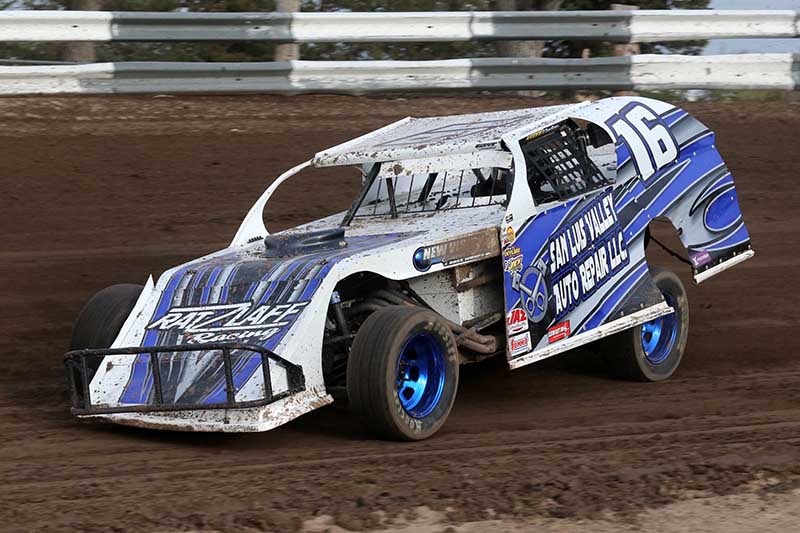
Matt Ratzlaff works the low side in his No. 16 Karl Kustoms IMCA Modified at Phillips County Raceway. (Photo by Carl Larson/Photos by Red)
Racing was a family affair.
Her sister, Genevieve Vannest, drove before her, while her other sister, Victoria Gallegos, was a familiar presence at the track as a flagger at multiple speedways.
Eventually, Christina found her own place behind the wheel.
She started in go-karts in 2003, moved into Mini Stocks in 2005, and continued climbing—IMCA Southern SportMods in 2010, Karl Kustoms IMCA Northern SportMods in 2016.
Each step built toward the next.
Now, she’s made the jump into IMCA Modifieds.
“The Modified is definitely more challenging, but it’s not completely new,” she said. “They drive similar to a SportMod, just faster and more demanding. Being in those for so long helped me adjust pretty quickly.”
That experience showed immediately.
Earlier this season, on April 11, the Ratzlaffs made the six-hour trip to Phillips County Raceway, where Matt picked up the opening night win.
That same night, Christina turned heads of her own—finishing third in her Modified debut.
“That was pretty cool for both of us,” she said. “To be that fast right out of the gate.”
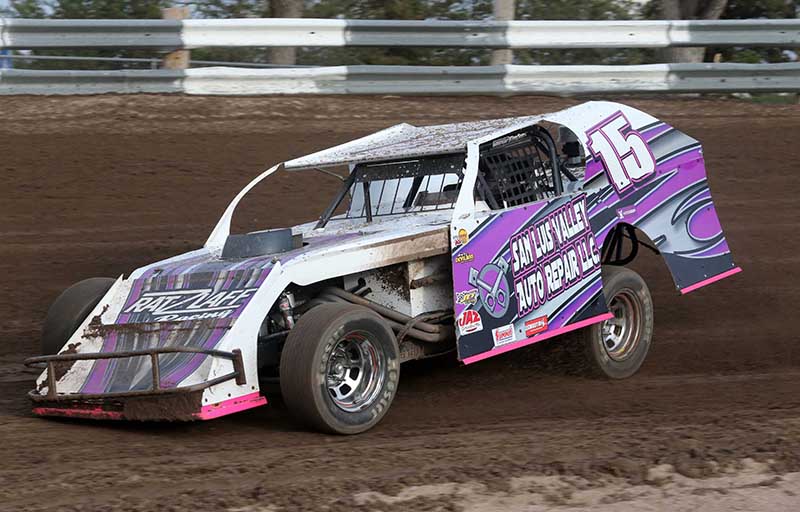
Christina Ratzlaff pilots the No. 15 Karl Kustoms IMCA Modified at Phillips County Raceway during 2026 competition. (Photo by Carl Larson/Photos by Red)
The Return of a Home Track
For both of them, Mosca Motorsports Park isn’t just another stop on the schedule.
It’s home.
And for years, it was gone.
“It was closed for about 15 years as a real race track,” Matt said. “People tried to bring it back, but it never really took off.”
That changed when new leadership stepped in. In 2025, Joe Bellm and BST Promotions took over with a commitment to bringing the facility back the right way.
“This group is putting real effort into it,” he said. “Not just making it a playground.”
For a region that had always supported racing, the return meant something deeper.
“I’ve been born and raised here, and that track was always something to do,” Matt said. “There was a core group of fans that showed up every week. People missed it.”
Christina felt that connection too.
“This has always been one of my favorite tracks,” she said. “My dad used to bring my car down here with his when I first started racing.”
Now, the track—and the community around it—is alive again.
Her father played a major role in shaping her path in the sport—both as a competitor and as someone who introduced her to the environment that would eventually define her life.
That’s also where another connection began to form.
Matt and Christina first crossed paths while traveling and racing alongside her father over the years, spending time at the same tracks long before they really got to know each other.
Eventually, that shared time at the racetrack turned into something more.
Now, they’re not just connected by racing.
They’re building a life—and a race team—together
Family First, Always
Racing may bring them to the track, but everything behind it is built on family.
Matt’s parents help care for their two daughters—ages 8 and 4—while they travel to race.
Their team has grown to include others as well, including Jeremy Steffens, a high school student who has become a regular part of the operation.
It’s not a big-budget team.
It’s a family effort.
Even the numbers on their cars tell a story.
Christina’s No. 15 traces back to her sister.
“When she started racing at 15, we just kept the number,” she said. “I’ve had different versions of it over the years—15¢, even $15—but now it’s just 15.”
Matt’s No. 16 comes from his own beginnings.
“My first full season, I was 16,” he said.
Life Beyond the Track
Life in the San Luis Valley doesn’t slow down—it just moves differently.
The valley stretches more than 100 miles from end to end, surrounded by towering mountain ranges, forming the largest alpine valley in the world. At its heart runs the Rio Grande, which begins in the nearby San Juan Mountains before winding its way south through the valley and into New Mexico.
Long before modern towns took shape, the region was home to Native Ute tribes. Permanent settlement followed in the mid-1800s, as Hispanic families moved north from New Mexico. The town of San Luis—founded in 1851 and named for Saint Louis—became Colorado’s oldest continuously inhabited town, established on the feast day of St. Louis.
The valley’s history runs deep. Routes like the Old Spanish Trail once passed through the region, connecting early trade and travel across the Southwest—long before modern highways crossed the same ground.
Today, that sense of history still lingers.
Monte Vista is home to one of the last operating drive-in theaters in Colorado, a small but lasting reminder of a slower pace of life that continues to define the valley.
“They’ve got two different screens and usually play two different movies,” Christina said. “There’s even a hotel there, so you can watch from your room.”
Each spring, thousands of visitors gather for the annual Crane Festival, where more than 20,000 sandhill cranes migrate through the nearby wildlife refuge—another tradition that ties the community closely to the land.
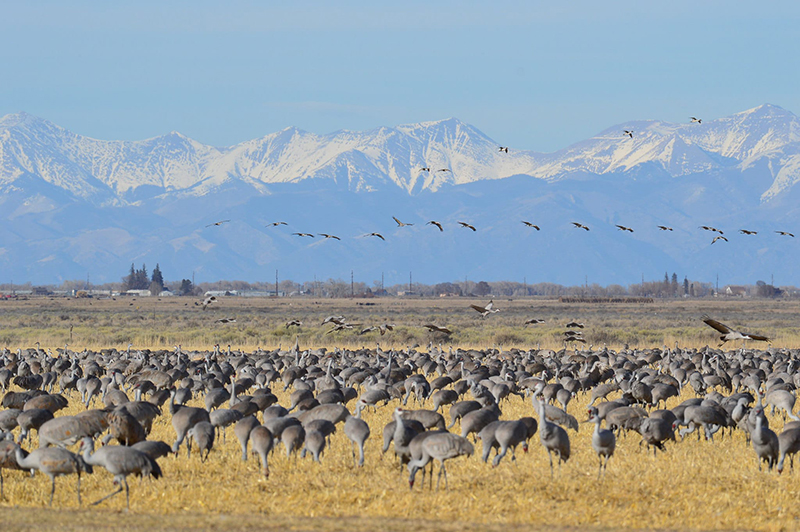
Thousands of sandhill cranes gather in the San Luis Valley during the annual Crane Festival, feeding in a barley field with the Sangre de Cristo Mountains rising in the background. (Photo by USFWS Mountain-Prairie)
Agriculture remains at the center of it all. Potatoes, cattle, and barley fields stretch across the landscape, while small towns remain tightly connected despite the distance between them.
“We live out in the country between Monte Vista and Del Norte,” Matt said. “There’s a lot to do outdoors—hunting, fishing, snowmobiling.”
When they’re not at the track, the Ratzlaffs take full advantage of everything the valley offers. Winters are spent snowmobiling through the mountains, while warmer months bring four-wheeling trips, time on horseback, and long days outdoors.
The Great Sand Dunes—rising unexpectedly from the valley floor—sit less than an hour away, offering one of the most unique landscapes anywhere in the country.
Mountain trails stretch for miles in every direction.
It’s a place where work and life are tied closely together—and so is their racing.
The Ratzlaffs operate out of San Luis Valley Auto Repair, a family-run shop that supports both their livelihood and their race program and the 2026 season is shaping up to be their busiest yet.
Plans include full schedules at Mosca, Cortez Fairgrounds Speedway, and Phillips County Raceway, along with the Colorado Alliance Tour.
With that schedule, they’ll be in position to pursue the Colorado State points title throughout the season, while also making select appearances at I-76 Speedway.
And for the first time, they’re setting their sights on Boone in September for the Speedway Motors IMCA Super Nationals fueled by Casey’s.
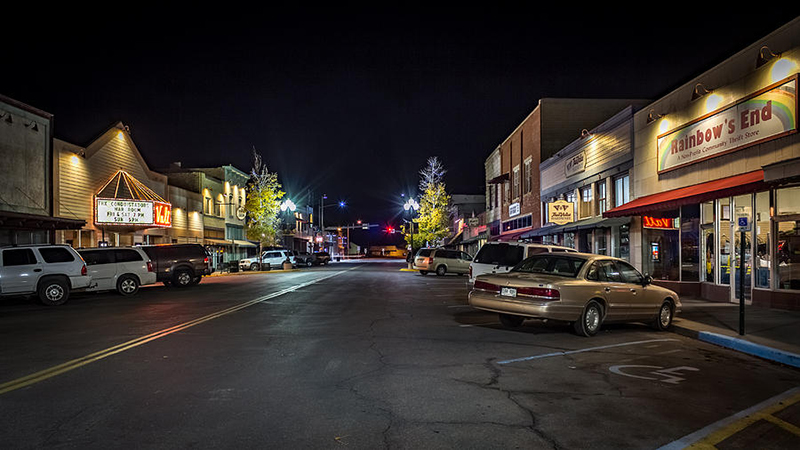
Downtown Monte Vista, Colorado—sitting at an elevation of more than 7,600 feet—reflects the quiet pace and historic character of life in the San Luis Valley. (Photo by Kenneth Michel)
Still Building, Together
From a chance night at the racetrack to a lifetime spent around it
To building a team side by side—Christina and Matt Ratzlaff didn’t just find racing.
They built their lives around it—together.
And in a place like the San Luis Valley, where distance is measured in miles and time is measured in seasons, that kind of journey carries weight.
Because out there, under wide-open skies and mountain views—
they’re not just chasing wins.
They’re building something that lasts.