By Ben Deatherage
MIDDLETOWN, Pa. (May 20, 2026) — In the heart of Central Pennsylvania sprint car country — where engines echo through the Susquehanna Valley and some of the biggest names in the sport compete — Stephanie Dodson has found her place.
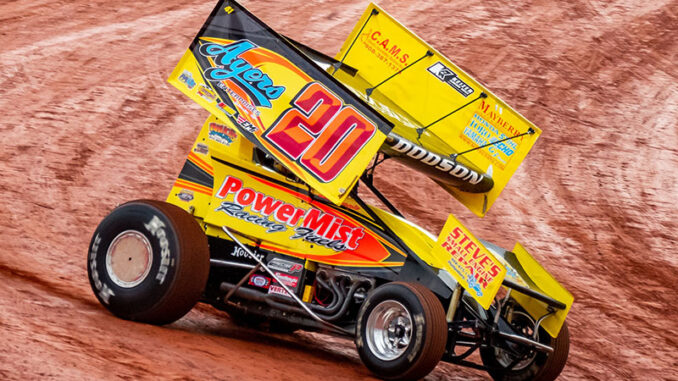
For nearly three decades, she competed behind the wheel, starting in go-karts before eventually moving into Midgets and RaceSaver IMCA Sprint Cars.
Today, it’s high above the track, in the announcer’s tower.
A former driver turned play-by-play voice of the PA Sprint Series, Dodson is part of a growing wave of women in motorsports — but still one of the few regularly calling races corner to corner.
It’s a role she never planned.
And a path that, like most of her life in racing, found her along the way.
Built Into Racing
“I don’t think I even had a choice to get involved in racing,” Dodson joked.
Her father, George Stevens, raced Stock Cars. Her uncle, Gary Stevens, competed across Pennsylvania, New York, and Canada in Small Block Modifieds. When her uncle stepped away after a serious crash, the next generation stepped forward.
“I started in go-karts when I was nine, and I was really slow at first until someone told me to just floor it and not lift,” she said with a laugh. “That’s what I did my first time out — except there was a crash in front of me. I didn’t lift, I flipped, and the kart landed on top of me. My mom thought, ‘okay, we don’t have to worry about her racing ever again.’”
She kept racing anyway.
Over the years, Dodson built a reputation as a respected competitor throughout Central Pennsylvania sprint car country.
But behind the scenes, the effort was never hers alone.
Behind much of that journey has been her Uncle Gary.
“Ever since I was little, Uncle Gary was in our garage every night, toiling away so that my brother and I could race,” she said.
Eventually, though, years of racing began to take a toll.
“I had gotten a lot of concussions, some from Midget racing because there’s no wing to slow you down,” she said. “I noticed my headaches were lasting longer after even minor bumps, and I thought maybe I should take a break.”
At the same time, her life with her husband Doug, who was also racing Sprint Cars, had them split between tracks on race nights.
“We were always at two different places, doing our own thing,” she said.
The solution came in a simple conversation in 2018.
“I told him, ‘I think I need to take a break from driving,’ and he thought it would be a good opportunity to shift his racing plans.
Doug took over the family car — a machine still tied to her roots. Her father, paralyzed from a 2012 accident, continued building engines. Her uncle remains a key part of the crew.
“He repairs frames, fabricates parts, builds wings, and does many other things so that we can race,” Dodson said. “He’s our main crew guy and is always there doing anything and everything to help.”
Racing stayed in the family.
Dodson just stepped into a different role.
Finding the Microphone
That next chapter came unexpectedly.
PA Sprint Series director Rod Ort reached out with an idea.
“He said something like, ‘all good athletes become broadcasters after they retire,’” she said. “I didn’t really know what he meant.”
Then came the ask.
Would she consider becoming the voice of the series?
“I was like, ‘okay, I guess,’” she said. “And that was it. We figured it out.”
The early nights were a learning experience.
“That first night, I had no idea what I was doing, and for a little while I just tag-teamed with the speedway announcers when the RaceSaver IMCA Sprint Cars were on the track,” she said.
Because the PA Sprint Series is a traveling RaceSaver IMCA Sprint Car series, Dodson had the opportunity to learn from a variety of track announcers along the way. Among them was Dave Hare at BAPS Motor Speedway, who helped her develop her approach — from organizing notes to talking with drivers and building stories that went beyond the race itself.
Now, she’s found her rhythm — and her voice.
Soon after transitioning from driving to announcing in 2019, Dodson had already earned respect in the tower, eventually stepping into a solo role with the PA Sprint Series.
“It meant a lot when the main track announcer gave up his spot,” she said. “That put me right in front of the broadcast and scoring monitors so I could stay in sync with the camera and have more information to work with.”
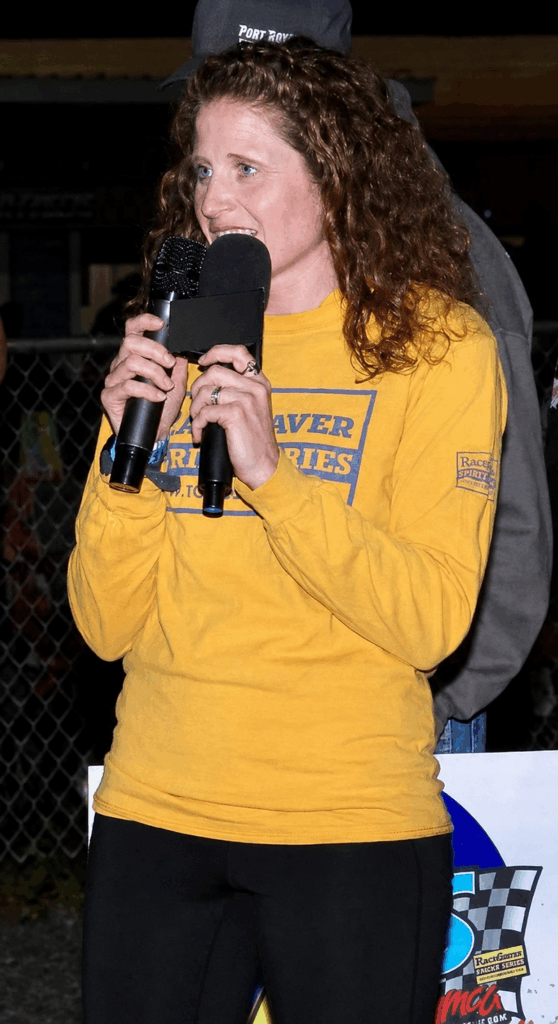
Stephanie Dodson addresses the crowd during PA Sprint Series competition, bringing the same intensity and passion to the microphone that she once carried behind the wheel. A former racer turned announcer, Dodson has become one of the recognizable voices in Central Pennsylvania Sprint Car racing. (Photo by Dan DeMarco)
A Voice That Stands Out
By the time Dodson stepped into the announcer’s tower, she had already spent 27 years behind the wheel.
In Central Pennsylvania, respect isn’t given — it’s earned. And long before she picked up a microphone, Dodson had already done that on the track.
She understands what drivers are dealing with in the car, how races unfold, and what goes into a night at the track beyond just the finishing order. That perspective carries over every time she calls a race.
But even with that background, the transition to the microphone brought a different kind of challenge.
“There was some pushback, especially in the beginning,” she said. “People aren’t used to hearing a female on the microphone.”
For someone who had already built a reputation as a driver, it was unexpected.
“I thought I had pretty thick skin, but some of the comments caught me off guard,” she said. “I just had to tell myself, go do my thing. It also helped to have a strong support system of family and friends.”
Over time, that confidence grew.
It helped that she was already used to thinking on her feet.
Away from the racetrack, Dodson’s life follows a different kind of pace.
She is a math teacher — a role she’s held for 15 years — and currently teaches at the high school level, spending her days adapting in real time, whether it’s answering questions, managing a classroom, or handling the unexpected.
“You never know what a high school kid is going to throw at you,” she said. “That helps with being on the mic.”
Her path into teaching wasn’t a straight one.
She began at Messiah University with plans to go into education, but quickly shifted into mechanical engineering, eventually earning her degree and working in the field. One of the projects she worked on involved designing specialized camera housings — including a camera embedded in a racing surface that became known as the “Gopher Cam.”
But something didn’t click.
“I didn’t like sitting behind a computer doing 3-D modeling all day,” she said.
So she went back to something that had always been in the back of her mind.
Teaching.
One of the most unique parts of her journey has been sharing the booth with Caleb Newlin.
“He started when he was 11, and people have fallen in love with him,” she said.
Dodson knew his family long before that — his father, Zach, raced when she did. Caleb had always been around racing, always narrating his toy cars and games.
One day, he asked to try the real thing.
They gave him a chance.
“And a star was born,” she said.
Now 13, he’s become a regular.
“He’s really good on the action calls,” she said. “I’m more focused on lineups and personal stories.”
Together, they’ve built something different — a broadcast rooted in both experience and energy.
From Phillipsburg to Middletown
Dodson’s story stretches beyond the racetrack.
She grew up in Harmony Township, New Jersey, along the Delaware River across from Easton, Pennsylvania — home of the Crayola crayon factory — in an area shaped by industry, movement, and a deep-rooted connection to racing.
Harmony itself was once home to a popular race track in the 1960s, adding another layer to the region’s motorsports history.
The township was incorporated in 1839 from portions of Greenwich and Oxford Townships and was named for early settler Harmon Shipman. Over time, parts of the area were split off, including the creation of Phillipsburg in 1851.
It was a place built on hard work.
And that mindset stuck.
Today, she lives in Middletown, Pennsylvania — a town founded in 1755 along the Susquehanna River that grew as part of the state’s canal system and early transportation network. It sits between the state capital of Harrisburg and Hershey.
Located just a few miles from the site of the 1979 Three Mile Island accident, the area experienced one of the most significant nuclear events in U.S. history, when a partial meltdown at the nearby power plant led to widespread concern and the temporary evacuation of thousands of residents. It was a moment that tested the region’s resilience and left a lasting impression on the community.
Not far from town, places like Indian Echo Caverns — natural limestone caves once used by the Susquehannock people and later opened to the public — offer a different connection to the area’s past, reflecting a landscape shaped by both history and time.
“You’re right between everything,” Dodson said. “Hershey’s right there, the capital is right there, and there are so many race tracks within an hour.”
For Dodson, it’s the perfect place to be — close to racing, but grounded in something deeper.
One of the things that drew her to Messiah University in Mechanicsburg was its proximity to Williams Grove Speedway.
“That was a selling point for me,” she said. “I could hear cars one Tuesday night and I went over to watch.”
It was there she first crossed paths with names she would later become familiar with in the sport, including Lance Dewease — long before his son Cole became part of the next generation she would help cover.
Life Beyond Racing
For years, racing was everything.
“Before my dad got paralyzed, racing was our life,” she said. “If we did anything else on the weekend, that was bizarre.”
That changed.
Now, she and Doug look for something different.
“We love being outside. We’re hikers.”
What started small turned into something bigger — a shared pursuit of distance, challenge, and time away.
They’ve traveled across the country and beyond, exploring places far removed from the racetrack.
But one trip stands out.
A year after getting married, they took their honeymoon to California, where one experience pushed them well outside their comfort zone.
Half Dome.
The iconic hike in Yosemite National Park isn’t something you stumble into. It requires a permit, preparation, and a willingness to take on one of the most demanding climbs in the country — rising to nearly 9,000 feet above sea level.
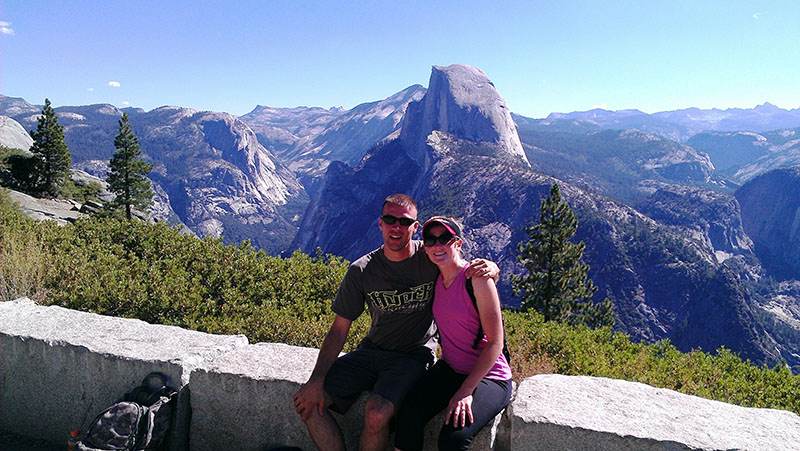
Doug and Stephanie Dodson pose near Half Dome during a 2013 trip to Yosemite National Park. The couple later climbed the iconic granite formation, which rises nearly 8,800 feet above sea level and requires hikers to use cables and safety equipment for the final ascent. (Courtesy Photo)
For the final stretch, the trail gives way to a steep granite face, where climbers use cables, carabiners, and harnesses to pull themselves upward.
Dodson was right there, clipped in and making the climb.
It wasn’t easy.
But it was worth it.
That trip was only the beginning.
In Zion National Park, they secured access to “The Wave,” a rare and tightly controlled hiking destination along the Arizona-Utah border known for its flowing sandstone formations and fragile terrain.
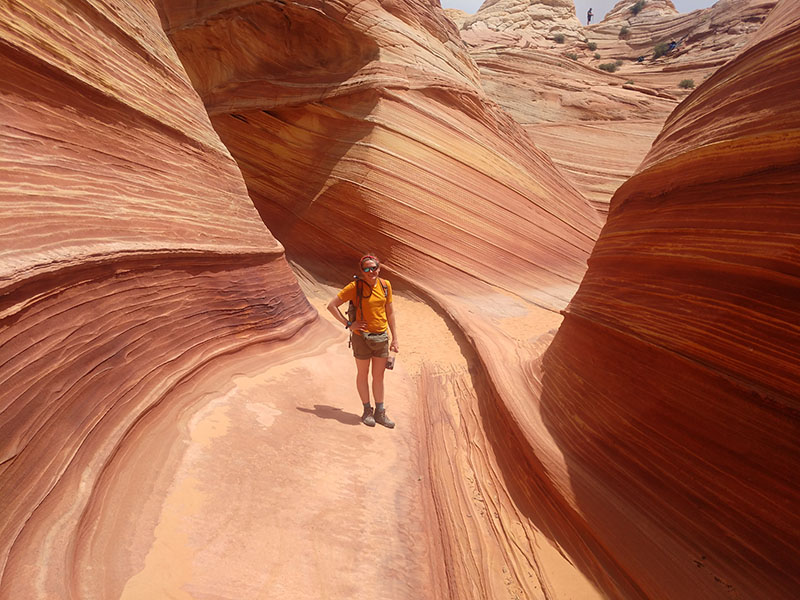
Stephanie Dodson stands among the sandstone formations of “The Wave” during a 2019 hike along the Arizona-Utah border. Access to the remote hiking area is tightly limited through a permit lottery system because of the fragile desert terrain. (Courtesy Photo)
Reaching it requires navigating open desert with no marked trail, using landmarks and GPS to find your way across miles of sand and rock. The formations — layered and sculpted by wind over thousands of years — create narrow passages and rolling patterns that feel almost unreal.
Because of how delicate the area is, only a limited number of hikers are allowed in each day.
“We somehow got it,” she said. “I don’t know how, but we did. It was really cool.”
They’ve since expanded their travels to places like Iceland, Olympic National Park in Washington State, and continue to plan new trips, including Banff in Alberta.
Still, one goal remains close to home.
The Appalachian Trail.
“I’m obsessed with it, and Doug supports me,” she laughed. “We have about 15 miles left in Pennsylvania.”
It’s not unusual for them to cover 15 miles in a day.
Like racing, it demands endurance.
But it also offers something racing can’t.
A break.
“We like it because we can get away from everything else,” she said. “Just walk, climb, and be outside.”
At the Center of It All
Today, Dodson balances multiple roles — announcer, co-director of the PA Sprint Series, teacher, and part of a racing family still deeply involved in the sport.
The PA Sprint Series continues to thrive, averaging strong car counts at tracks across the region.
“We’re lucky to have so many tracks,” she said. “Last year we averaged 33 cars per race.”
For Dodson, it’s about more than calling races.
It’s about telling the stories.
She didn’t plan this path.
But she found it.
Now, from the tower, she sees the sport from a different perspective.
Still connected to it.