By Ben Deatherage
VANCOUVER, Wash. (Mar. 18, 2026) — For years, Jerry Schram lived on borrowed time.
Three days a week, four hours at a time — sometimes far more — he sat connected to a dialysis machine, waiting for it to do what his body no longer could. When the treatments ended, the exhaustion didn’t leave with him. It followed him home.
“Dialysis is tough on you,” Schram said. “You start to think it’s killing you slowly — but it’s better than the alternative.”
For nearly six years, that was life.
Until March 3.
That’s when everything changed.
A Fight That Took Years
Schram’s battle with kidney disease didn’t begin with a dramatic moment. It started quietly in November of 2017 during a routine physical, when doctors discovered blood in his urine. Follow-up testing revealed he was already in end-stage renal disease, operating at just 35 percent kidney function — something he hadn’t even realized.
The seriousness of it didn’t fully hit until March of 2018, when he underwent hip replacement surgery and doctors warned they had to be careful with medications because of his condition.
“That’s when it really brought to life how serious it was,” he said.
At first, his kidneys functioned well enough to delay treatment. But by November of 2019, a peritoneal dialysis catheter was placed as his condition worsened. He officially began peritoneal dialysis in June of 2020, marking the start of years spent managing life around treatment.
Life quickly became structured around survival.
At one point, Schram was on dialysis as much as 16 hours a day, seven days a week. Even after transitioning to hemodialysis in late 2024, the toll remained.
“I had to go Monday, Wednesday, and Friday for four hours,” he said. “When you’re done, it knocks you in the dirt. You come home and go to bed for four or five hours.”
Simple things became difficult. Travel was limited. Time with family was interrupted. Daily life revolved around treatments.
“Dialysis is life support,” said his wife, Christi. “People think, ‘Oh, you’re just on dialysis,’ but it truly is life support. Without it, you have about 10 days.”
At first, Schram resisted.
“I didn’t want to do dialysis,” he said. “I thought I could live through it.”
That changed during a trip to Nevada.
“I could barely get in and out of the race car. I was so weak,” he said. “I knew it was time or I was going to die.”
By then, his kidney function had dropped to just five percent.
Even getting on the transplant list became its own fight. He was removed twice — once after needing heart stents that required blood thinners, and again following vascular surgery on his leg. Each time meant starting over.
“They’d say, ‘As soon as your doctor releases you, we’ll put you back on the list,’” he said. “But it’s not that simple. It could take three to six months just to get back on, and you have to go through all the testing again. It would make me go crazy sometimes.”
With an O-positive blood type, the wait for a deceased donor could stretch six to seven years.
So in 2024, the family turned to the community.
“We made a Facebook post saying Jerry needed a donor,” Christi said. “We had a few people try, but they can rule you out pretty quickly.”
What they didn’t know was that someone had already seen it.
An Unexpected Answer
Andrea Cadotte didn’t hesitate.
She saw the post — shared through connections tied to Sunset Speedway Park — and felt something she couldn’t explain.
“I don’t know what it was about that post,” she said. “But it made me want to get tested.”
Cadotte has deep roots in the Sunset Speedway Park racing community. She raced there herself, winning a women’s division championship in 2012, and her brother Joey is a Sunoco IMCA Stock Car competitor at the same facility. Her sister-in-law, Mandie Tardio, has also been heavily involved — previously sharing a car with Andrea during her racing days and currently working at the track in staging.
The connection goes back even further. After her family moved to Banks in 1996, Cadotte grew up knowing the speedway was there. In 2009, while driving past the track, Joey mentioned he thought he could build a race car. Not long after, he did — sparking the start of the Tardio Racing Team and a lasting family connection to the sport.
But her decision to donate was shaped by something much deeper — her mom, JoAnn Strickland.
“In 2020, I was approved and had a surgery date scheduled to donate half my liver to my mom,” she said. “She sadly became too ill prior to the surgery and ultimately passed away.”
That loss stayed with her.
“I really felt drawn to donating to Jerry because so many people cared for him,” Cadotte said. “I felt like if I could keep one family from having the same pain as ours, I would do it in a heartbeat.”
In many ways, the experience helped bring a sense of healing.
“Donating to Jerry helped heal the wound from not being able to donate to my mom,” she said. “She’s the reason I’m such a strong woman today and the guiding light behind choosing my career in firefighting.”
For Jerry and his wife Christi, the impact goes far beyond the surgery itself.
“Jerry and I both feel she was once a stranger and now will be family for life,” Christi said.
Cadotte has spent years serving others. She volunteered for nine and a half years with Banks Fire, worked as a firefighter-paramedic in Keizer, and now serves with Lake Oswego, where she has been for nearly a decade.
Test after test confirmed she was a match.
“My blood work looked great. My kidneys were high functioning,” she said.
Even within her own family, the decision wasn’t automatic.
“My brother Joey actually wanted to donate first, so I stepped back,” she said. “But due to restrictions with his job, he couldn’t — so I stepped back in.”
Schram had no idea.
“We had no idea Andrea was testing,” he said.
On March 3, everything came together. Cadotte went into surgery at 7 a.m., and Schram followed later that afternoon. Even then, there were concerns. His age and vascular condition could have complicated the procedure.
Instead, it went better than expected.
“Jerry’s surgery went better than anyone anticipated,” Christi said. “Andrea is such a rockstar.”
Cadotte’s recovery has been strong.
“It was a lot less painful than I thought it would be,” she said.
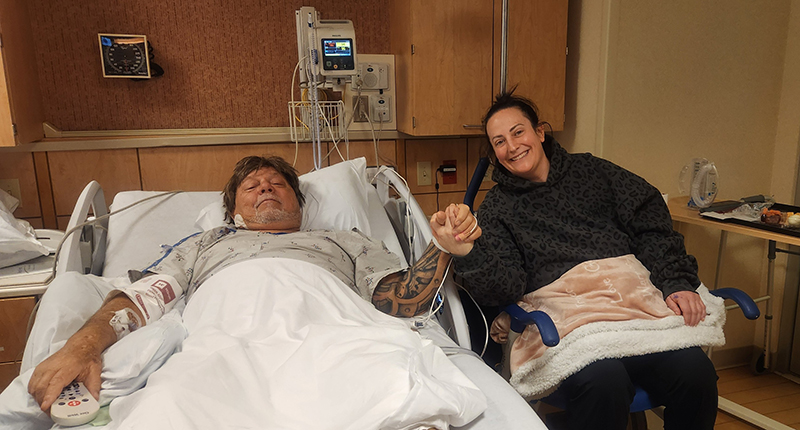
Jerry Schram and Andrea Cadotte share a moment following transplant surgery, marking the beginning of recovery after a life-saving kidney donation. (Courtesy Photo)
She’ll continue to be monitored with a follow-up appointment two weeks after surgery, followed by additional check-ins at six months, one year, and two years to ensure her body continues to adjust properly.
For Schram, the difference is already clear.
“We’re all doing really well now,” he said. “I’m a little sore, but we’re getting through it.”
Now, instead of spending hours hooked to a machine, his days are focused on healing.
For the first month, Schram returns twice a week — Mondays for blood and urine tests, and Thursdays for additional lab work and meetings with the transplant team to monitor progress and adjust medications. In the second month, visits scale back to once a week, and by the third month, the routine is limited to bloodwork as doctors confirm he is on track to fully recover.
“It’s a lot,” he said. “But it’s better than what was going on before.”
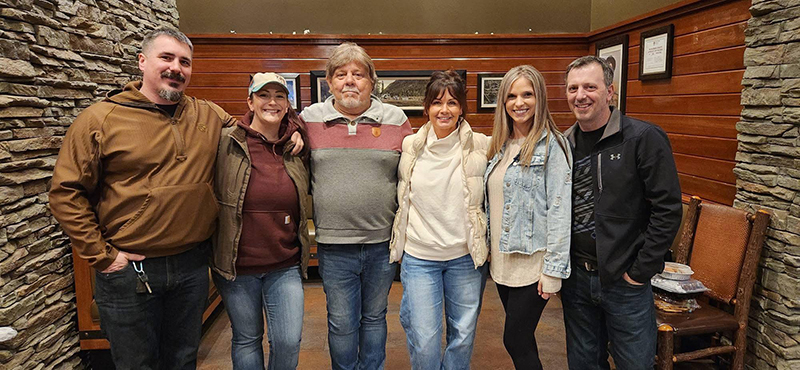
Pictured left to right: Kyle Cadotte, Andrea Cadotte, Jerry Schram, Christi Schram, Mandie Tardio, and Joey Tardio. The families were brought together through racing and are now forever connected by the life-saving kidney donation. (Courtesy Photo)
A Second Chance Built in Racing
Long before his health battle, Schram built a lasting legacy in the Pacific Northwest racing scene — both behind the wheel and as one of the region’s most influential promoters.
His path to racing began after the passing of his mother, though horses had been a big part of his life before that.
“My dad used to race years ago at Portland, but when my mom was around we were heavily into showing horses,” he said. “After she passed away, we were looking for something to do, and my dad said, ‘Why don’t you try racing?’”
After watching a local race, he was encouraged to make his way to Lebanon, where he quickly fell in love with dirt track racing.
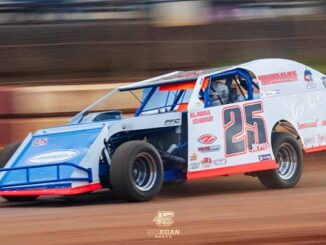
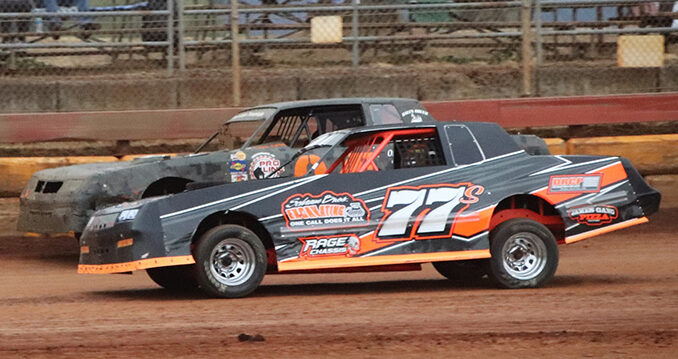
“I bought a car from Mike Miller but never raced it,” Schram said. “Gene Day got a new car, and I bought his and raced it the next year in 2000. My dad ran no. 77, and Gene did too, so that’s why I’ve always run that number.”
In 2005, Schram became a silent partner at Sunset Speedway Park. Located just off the main drag in Banks, Oregon — a small town a little over 20 miles as the crow flies from downtown Portland — the track would become a centerpiece of his impact on Pacific Northwest racing. After the passing of Doug Walters in 2008, he took over as promoter and helped shape the future of the facility.
His involvement in the sport continued to grow, and by 2013 he became heavily invested in Speedway Motors IMCA racing, helping bring the Karl Kustoms IMCA Modified division back to the Pacific Northwest. He also competed himself after helping re-establish the class.
He continued to build on that foundation, introducing Karl Kustoms IMCA Northern SportMods in 2014 and helping add IMCA Stock Cars in 2018. He also serves as the promoter of IMCA Wild West Speedweek, overseeing one of the region’s premier summer tours.
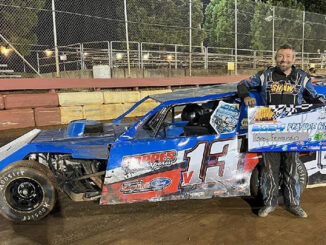
Even with those responsibilities, his competitive drive never left. In 2022, Schram captured the IMCA Stock Car championship at Sunset Speedway Park — a full-circle moment at the track he helped build into a regional staple.
His reach extended across multiple facilities. He was part of the promotion team at Grays Harbor Raceway from 2010 to 2013 alongside the late Greg Biffle, and the two built a friendship that went beyond racing.
Before working together at Elma, the two would often run into each other at a local Vancouver gas station, striking up conversations about where Biffle was headed next. Those chance encounters grew into a genuine friendship.
When Biffle became involved at Elma, he helped elevate the program — bringing in sponsorships and using his platform to support racers. He also made appearances at Schram’s tracks that benefited his charity.
“He always wanted to help racers out,” Schram said.
Schram purchased Willamette Speedway in 2011, completed a major overhaul of the facility, and remains the owner today. He also owned Cottage Grove Speedway until selling it to longtime general manager Heather Boyce in 2020.
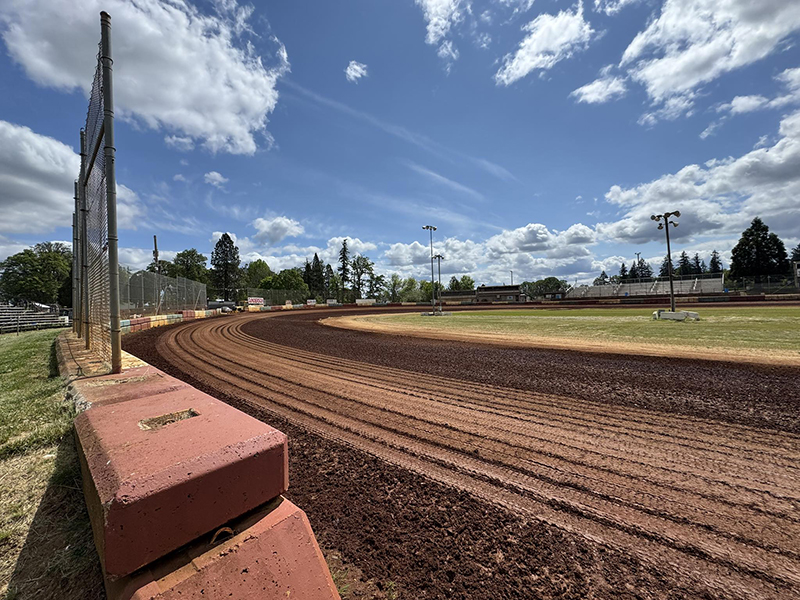
Sunset Speedway Park sits just outside downtown Banks, Oregon, a 1/4-mile clay oval bullring located just over 20 miles from downtown Portland. (Courtesy Photo)
Now, the focus has shifted.
Not to race nights or promotions, but to something far more personal.
Gratitude.
“Andrea is such an angel,” he said. “I’m so thankful for her.”
For Cadotte, the experience has left a lasting impression.
“It’s been eye-opening how many people need kidney donations,” she said. “If you’re healthy and feel like you want to do something more, there’s no reason not to get tested.”
For Schram, the meaning is simple.
After years of fighting, waiting, and enduring, he has something he was never guaranteed.
A second chance.
One no longer measured in treatments and time limits — but in moments, family, and the chance to truly live again.
If you are interested in becoming an organ donor, you can register through your local DMV or visit your state’s donor registry online. You can also speak with your healthcare provider to learn more about the process.