By Ben Deatherage
SCOTTSDALE, Ariz. (Mar. 18, 2026) — In the Yukon, the air is so clean you can drink from the streams. The country stretches wide and wild, with mountains on the horizon, deep cuts in the earth, and wildlife moving through a landscape that still feels untamed. In that far-north world, where long days of summer labor are measured against cold, distance, and the uncertainty of what lies beneath the ground, Brian McCaughan has built a life chasing one of the planet’s oldest prizes.
Gold.
It is a life shaped by risk, patience, hard work, and wonder. Some days the earth gives something back. Other days, after moving millions of tons of dirt, there is almost nothing to show for it. But for McCaughan, the beauty of the Yukon and the challenge of making a living there have become part of who he is.
Maybe that is why getting back into racing made sense.
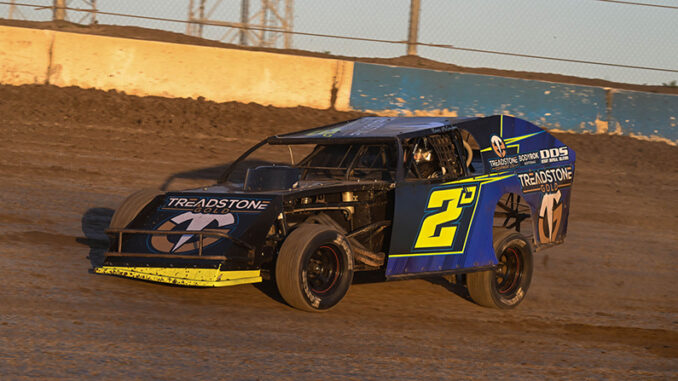
The driver of the no. 2D Karl Kustoms IMCA Modified once raced Modifieds and Late Models regularly and made a couple of trips to the Speedway Motors IMCA Super Nationals fueled by Casey’s. Then life carried him in another direction. For years, racing faded into the background as business, family, and eventually gold mining took center stage.
Now, after a long absence, McCaughan is back behind the wheel.
And what has made the return even more meaningful is that he is doing it alongside his son, Gage.
Back to Racing With Family
McCaughan’s roots in racing run deep.
“I’ve been around and switched to Sprint Cars and Late Models, then sort of didn’t do a lot of racing for several years until my son wanted to get into it,” McCaughan said. “Both my parents raced. My mom ran in the powder puffs. I was the next in my generation to race, and my family actually built a track south of Calgary and ran that for seven years.”
That family track became both a blessing and a turning point. Helping operate the facility pulled him away from competing, and eventually racing gave way to other pursuits.
His son, though, kept the connection alive.
“My son Gage got into racing Mini Sprints when he was seven years old, and he raced when we had the track until we shut that down and went gold mining in the Yukon,” McCaughan said. “We couldn’t do anything in the summers for the last 14 years, so now we are like, ‘Let’s go run in the south because we have winters off now.’”
The return started with a trade.
“We had a couple of Late Models hanging around and traded them for a Modified and a trailer,” he said. “Gage said he wanted to go and I said I would be his crew chief. It was fun, and then we ended up winning a raffle at the track, which helped put money towards two cars that Gage found. He told me, ‘Dad, you need to come race with me,’ and I said I’d give it a try.”
For a racer whose earlier years came before four-bar cars became common, the adjustment took time.
“We didn’t have much for four-bar cars when I was racing. They were just coming in toward the end,” McCaughan said. “It’s quite a different kind of car to drive, and it took me a little longer to get used to it.”
Still, the chance to race with family has made the learning curve worth it.
“Racing with Gage has been awesome,” he said. “He still hasn’t passed me. The last race he was close to passing me, and I saw him on my right side a couple of times. It’s been a lot of fun. I wouldn’t say it was a dream of mine, but now that I’m doing it, it’s a highlight of my life.”
From the Oil Patch to the Klondike
McCaughan stepped away from racing around 2000, but he did not slow down.
Instead, his path eventually led north into one of the harshest and most unforgiving businesses imaginable.
“We were way up north in the tar sands working and ended up getting ripped off on a big project,” McCaughan said. “We were leaving town with our equipment and didn’t know where to take it, and I had a friend who told me he had some mining claims and ground up north. We went up to the Yukon and I traded a bunch of equipment for mining rights and we started mining.”
The early years were brutal.
“The first five years were very difficult, but we slowly got a little bit smarter and now we’re toward the top of the food chain,” he said. “It was a long, drawn-out process and a very difficult business. Not just anybody goes into it, and it takes a specific person to succeed.”
McCaughan was careful not to rush headlong into the venture. While many people jumped into mining and went broke, he took a slower approach, keeping his Alberta businesses going while learning the trade.
“I was smart enough not to jump right into the mining business because a lot of people that do that go broke,” he said. “So I kept running my business in Alberta and dabbled into the mining stuff and started with a small crew and learning, because there’s so much to learn. We lost so much gold at first because we didn’t know what we were doing, and I look back and just shake my head.”
Eventually, the business began to click. McCaughan and his family built up multiple enterprises to survive the learning curve, including trucking, commercial equipment buying and selling, and mining.
“We had a trucking business while we were mining and then a commercial business to buy and sell equipment, so we had multiple different businesses to stay alive in the gold business,” he said. “Only the last five years of gold mining has really kicked in, and we’ve gotten the big equipment and drills where anything you can do in bulk, you have a chance at success. We’ve done quite well.”
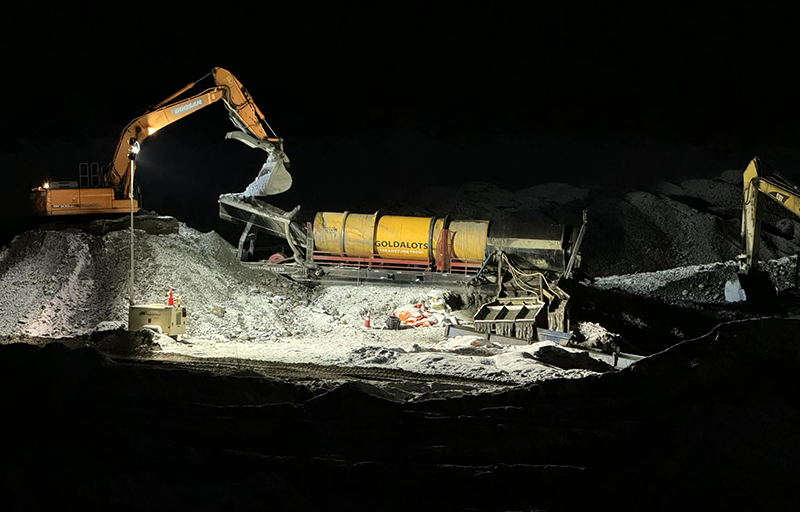
Heavy equipment works under the lights during nighttime mining operations, a routine part of the demanding schedule in the field. (Courtesy Photo)
Life in the Yukon
Mining season generally runs from March to October, with the short working window dictated by extreme weather and the realities of life in the far north.
McCaughan’s operation is based near Dawson City, in the heart of Klondike country, where the gold rush of the late 1890s once drew thousands of prospectors north in search of fortune. Today, the landscape still carries that same frontier character, even if the methods are more modern.
The region’s history is inseparable from the Klondike Gold Rush, when an estimated 100,000 prospectors headed for the Yukon between 1896 and 1899 after news of major gold discoveries spread across North America. Dawson City exploded into a boomtown, and while most fortune seekers came away empty-handed, the Klondike became one of the most famous gold regions in the world.
McCaughan knows that history well, but he also knows the modern reality.
“We surface mine and process the gold right there and have it ready for sale on site,” he said. “We process nuggets and find gold and sell it to different buyers in the Yukon. It’s kind of nice having your profits in your own hands and not wait for a check to show up in the mail. You don’t have to hire a lawyer to collect money. It’s a very interesting business and very rewarding.”
It is also brutally unpredictable.
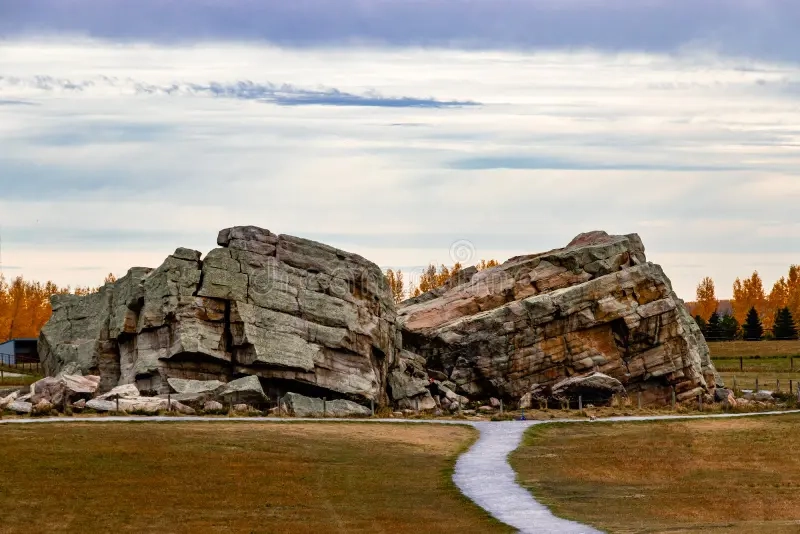
Okotoks’ iconic Big Rock, a massive glacial erratic and well-known landmark in southern Alberta, stands as a reminder of the region’s geological history. (Photo by Dreamstime)
“Sometimes we go down 100 feet and find a lot of gold, and sometimes we go down 100 feet and don’t find any gold,” McCaughan said. “We do these massive pits that we call cuts. They’re 300 feet by 400 feet and go down about 80 feet deep, and you take gold that would fit in a few jars and put all the rest of that dirt back. Millions of tons of dirt get moved to find this stuff. When you look at it that way, it makes it seem crazy. It’s high risk and high adrenaline, and it’s very rewarding as long as you’re making money, because we’ve seen a lot of people go broke.”
The environment adds another layer of challenge.
“Right now I was supposed to be up there in Dawson City, but it’s minus-33 right now when it should be minus-13, so the weather can cut into your mining season,” he said. “Weather is a factor, employees can be a nightmare of a factor, and you’re concentrating so hard because you’re at the end of the road up there.”
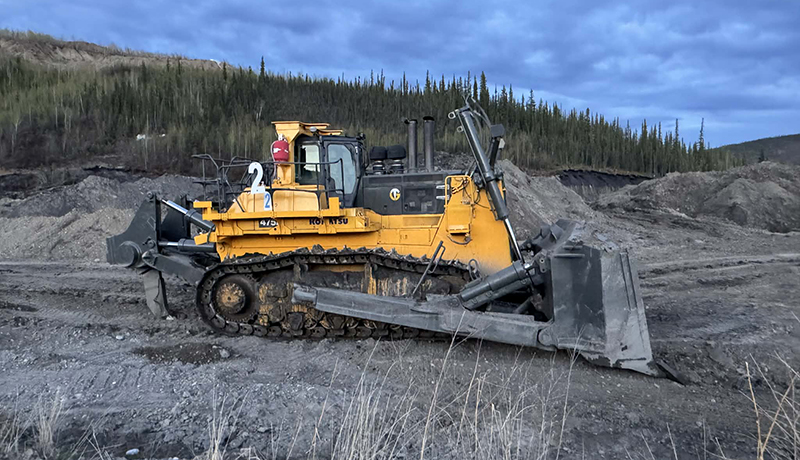
One of Brian McCaughan’s Komatsu D475 dozers, bearing the No. 2 just like his race car, sits at a remote mining site. (Courtesy Photo)
Remote, Rugged, and Beautiful
Despite the hardships, McCaughan speaks about the Yukon with genuine admiration.
“We are neighbors to a lot of the guys on the Gold Rush show and know them very well,” he said. “Everyone should go up to the Yukon once in their lifetime and see the beauty and lifestyle. The air is so clear and clean, and we still drink out of the streams. It’s such a beautiful, clean place to work.”
The lifestyle, he says, is unlike anything else.
“For us, we work hard for seven months and take five months off,” McCaughan said. “It’s a very unique lifestyle. It’s almost like you’re farming except you’re mining.”
That isolation means everything has to be thought through in advance, from equipment to housing to meals.
“We are seven hours from the nearest fast food restaurant, so we are in the middle of the bush,” he said. “We have a commercial camp like you would have in the oil patch. The units are well insulated and air-conditioned and have a commercial kitchen. As you step up and grow, you get better accommodations, and you can keep people longer if you offer a nicer camp and food. The little things matter if you get the right people.”
The unique nature of McCaughan’s operation even brought national attention. He and Treadstone Gold were highlighted through their connection to the television series Gold Rush, and in 2022 the company became part of a remarkable discovery when a mummified baby woolly mammoth was found on one of their claims in Trʼondëk Hwëchʼin Traditional Territory.
The calf, later named Nun cho ga, was identified as one of the most complete mummified woolly mammoths ever found in North America, a discovery of major scientific importance.
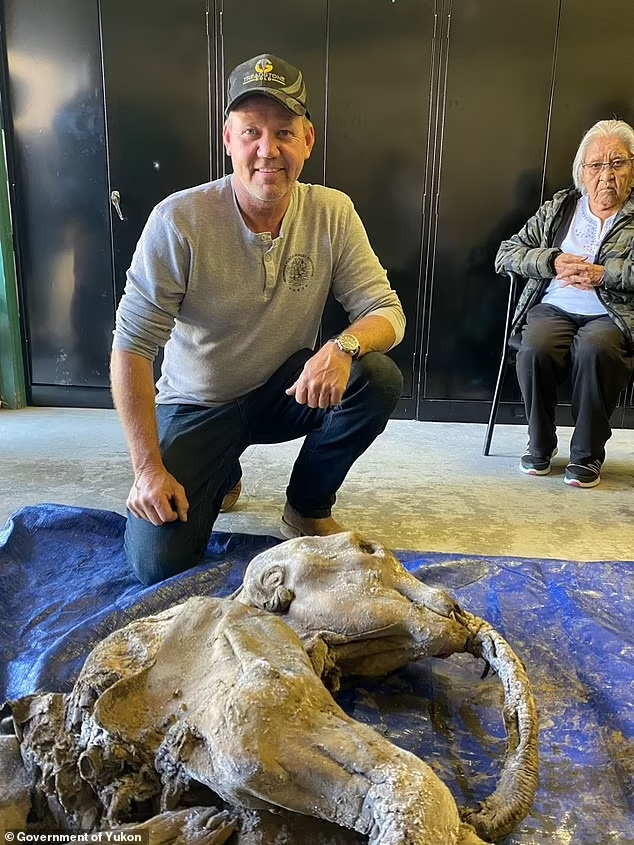
Brian McCaughan poses with the remarkably preserved 30,000-year-old baby woolly mammoth calf discovered by Treadstone Mining in the Yukon, one of the most significant finds of its kind in the region. (Photo by Government of Yukon)
From Manitoba to Okotoks
Though his work has taken him deep into the Yukon, McCaughan’s long-time base has been Okotoks, located just south of Calgary.
Originally from St. Francis Xavier just west of Winnipeg, he spent about three decades in Okotoks for business, where he built his life.
“I’m originally from Winnipeg but moved over to Okotoks for about 30 years for business,” McCaughan said. “Okotoks is basically an outskirt of Calgary, about 15 minutes south and near the foothills, so you can get to Banff National Park in an hour.”
The town itself has a history rooted in travel and geography. Its name comes from the Blackfoot word for “rock,” a reference to the nearby Big Rock glacial erratic, a landmark that helped Indigenous peoples find a crossing of the Sheep River long before modern settlement. Later, Okotoks grew as a stopping point along the old trail between Fort Macleod and Fort Calgary before the railroad arrived in 1892.
In recent years, McCaughan has also spent increasing time in Arizona during the winter months.
“I’ve been coming down here for about 12 years, maybe more,” he said. “My brother had a place in Viewpoint RV Park, and I got a place next door, and it just became home, as I got older and older, staying longer and longer to where I stay down here in the winter and then up there during the warmer months.”
Gratitude and Perspective
For McCaughan, racing today is about far more than competition.
It is about family, time, and perspective.
“We get to work with our family and race with them and play with them, and that’s an amazing thing,” he said. “We spend so much time up there in the summer while Gage and his brothers, Chase and Bryce, run the mines, and I go around town picking up the parts and pieces we need,” he said. “Then we live down here in the winter, and it’s pretty damn cool.”
He is quick to credit the people who help make both the racing and the rest of life possible.
“I want to thank my new partner Summer, my family, friends, and everyone who came together to help,” McCaughan said. “I’ve got friends from back in the day who come help us with racing, and we’re grateful for our great sponsors Treadstone Gold, BodyRock of Scottsdale, Desert Disposal Services, and Schaeffer’s Racing Oil with Jason Babyak.”
For a man who has spent years chasing gold in the Yukon and now finds himself back at the racetrack with his son, the rewards come in more forms than one.
Some are found at the bottom of an 80-foot mining cut.
Others are found under the lights, in a race car, with family close by.