By Ben Deatherage
BONHAM, Texas (Feb. 16, 2026) — In North Texas, where red dirt roads wind toward open water and family names carry weight long before trophies ever do, racing isn’t just a sport. In Bonham, one of the oldest cities in Texas, Shelby Williams grew up surrounded by roaring engines and racing stories that came with the Williams name, a lineage rooted as deeply in local racetracks as it is in family history.
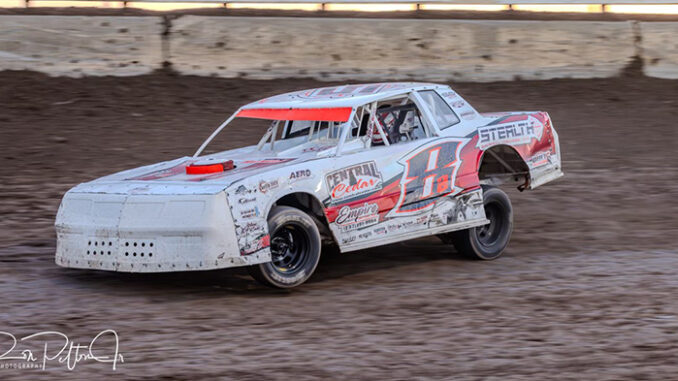
On January 24, 2026, beneath the desert lights of the IMCA TV Winter Nationals, Williams reached a milestone reserved for only a handful of drivers. He captured his 100th career Sunoco IMCA Stock Car victory, earning entry into the division’s prestigious Century Club and cementing his place among Texas dirt racing’s modern standouts. The moment itself unfolded in a fashion that mirrored his driving style — patient, observant, and calculated rather than flashy.
“I wasn’t too excited about the main event going in,” Williams admitted. “Last year, you pretty much had to start on the front row, so I didn’t expect too much. But I knew we had a good car and it was fast.”
As the race developed, the groove changed — and Williams adapted faster than the field.
“Luckily the top kind of went away that night and there wasn’t a big cushion for everyone to lay on,” he said. “I found a bit of moisture on the bottom, and by the time everyone else found it I was ahead of them all. It just worked out just right.”
The week itself had tested his resolve before the breakthrough ever came. Early DNFs — two from incidents not of his making — and an electrical failure threatened to derail the run before it gained traction. But perseverance, a trait woven through his career, prevailed.
Reaching the Century Club places Williams among elite company. Only five other Texas drivers have surpassed the 100-win mark in IMCA Stock Cars, led by Duain Pritchett’s 228 victories, followed by Benji Kirkpatrick, Jeff Turner, Jason Batt, Matt Guillaume — and now Shelby Williams.
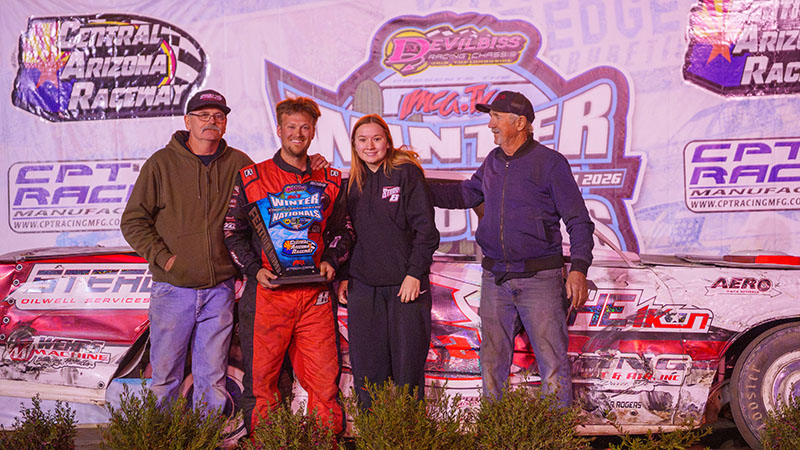
Shelby Williams celebrates in victory lane following his 100th career Sunoco IMCA Stock Car victory, achieved during the IMCA TV Winter Nationals at Central Arizona Raceway on January 24 (Photo by AOM Creative)
Built From the Back
Long before he traveled around the country, Williams’ racing story began in far humbler fashion, shaped by modest means and relentless curiosity. He and his older brother Kelly didn’t start in polished go-karts or funded equipment — they started in yard karts that barely cracked 10 miles per hour, racing laps around their neighborhood simply for bragging rights.
“We were pretty poor when I first got into racing,” he said. “We didn’t have any go-karts. Me and my brother just had yard karts and raced each other around the block.”
Kelly raced first, opening the door. Shelby followed soon after — even if it meant bending the rulebook slightly.
“You were supposed to be 12 to race Mini Stocks and I was 11, but nobody checked back then,” he laughed.
Traveling to Abilene Speedway for his first race remains seared into memory — not for success, but for chaos.
“We went into turn one and this guy came down when I was already there. I hit him and he flipped. My very first race — I thought I was going to get beat up or black flagged.”
A pivotal chapter came in a traveling Mini Stock series promoted by Tony Hernandez. One dominant season saw Williams win nearly every race — until Hernandez intervened, forcing him to start at the rear.
“I told him I wasn’t starting in the back for $100,” Williams recalled. “So he put me back there anyway.”
The lesson proved invaluable. Williams still won — repeatedly — eventually claiming 17 victories in 19 races from dead last starts.
“At the time I wanted to beat him up,” he admitted. “But now I realize he saw something in me. It taught me how to get through traffic and predict what guys are going to do.”
That foundation shaped everything that followed. Williams began racing in 2005 and transitioned into IMCA Stock Cars full-time around 2015. For his 15th birthday, his father Gary — himself a racer — bought him his first full-sized stock car, that was rebuilt by students at Ennis High School.
Gary made sure racing knowledge extended beyond the driver’s seat.
“He told me if I wanted to learn how to race, I needed to learn how to work on it,” Williams said. “Every day after school I’d walk to the shop and work on my car. Summers I was there while my friends were out doing other stuff.”
Today, Williams still sets up his own cars, drawing from lessons learned traveling to events like the Dakota Classic Tour, Clash On The Coast, and the Speedway Motors IMCA Super Nationals fueled by Casey’s — experiences that broadened his adaptability across track styles and surfaces.
The Weight of No. 82
Racing, for Williams, has always been generational. His father raced. Both grandfathers — Dennis Nelms and Jimmie Williams — were fixtures at Grayson County Speedway in Bells, a track that not only shaped competition but family history itself.
It’s where his parents met. Years later, it’s where Shelby met his wife, Kendall.
“They were kind of rivals back in the day,” Williams said of his grandparents’ families. “At first it was a rule she couldn’t date a Williams — but they ended up married.”
The family legacy carries onto his car in the form of No. 82, a number worn by his grandfather, father, uncle, and brother — a number that, like many racing traditions, started with something simple.
According to Williams, the origin traces back to his father’s idea while helping paint one of his grandfather’s race cars. As the story goes, they began writing out numbers from 1 to 100, searching for one that stood out visually on the body panels. When they reached 82, both agreed it simply looked the best — bold, balanced, and easy to recognize at speed. From that moment forward, the number became synonymous with the Williams name at the racetrack.
Financial hardship once forced a temporary alteration — turning Shelby’s early car into No. 821 — until he eventually returned to the family’s traditional 82 once he and his brother were no longer racing against each other.
Hometown Waters Run Deep
For Williams, Bonham isn’t just where he lives — it’s where his identity took shape. Situated in the Texoma region along the Texas-Oklahoma border, the city traces its roots back to 1837 and Fort Inglish before being renamed for Alamo defender James Butler Bonham, whose final ride into legend came during the siege of the Alamo in 1836.
Sent by William Barret Travis to seek reinforcements, Bonham rode east to Goliad to meet Colonel James Fannin — the namesake of Fannin County, where the city of Bonham now sits — but no aid could be spared and he was urged not to return. Refusing to abandon the garrison, he rode back toward San Antonio and into the besieged fortress. Three days later, Bonham was killed in the battle at just 29 years old — believed to have died manning a cannon inside the chapel — a sacrifice that forever tied his name to Texas frontier courage and, ultimately, the town that now bears it.
Railroads, colleges, streetcars, and even minor league baseball once filled the town with regional prominence, while World War II brought an air training base and a German prisoner-of-war camp to its outskirts.
Today, life moves at a quieter pace, defined more by open land and water than industry — something Williams embraces.
“The only cool thing about Bonham is we’ve got three lakes if you like fishing or swimming,” he joked, referencing Bois d’Arc Lake, Bonham Lake, and City Lake. “And the North Texas Safari Park — they’ve sponsored me sometimes.”
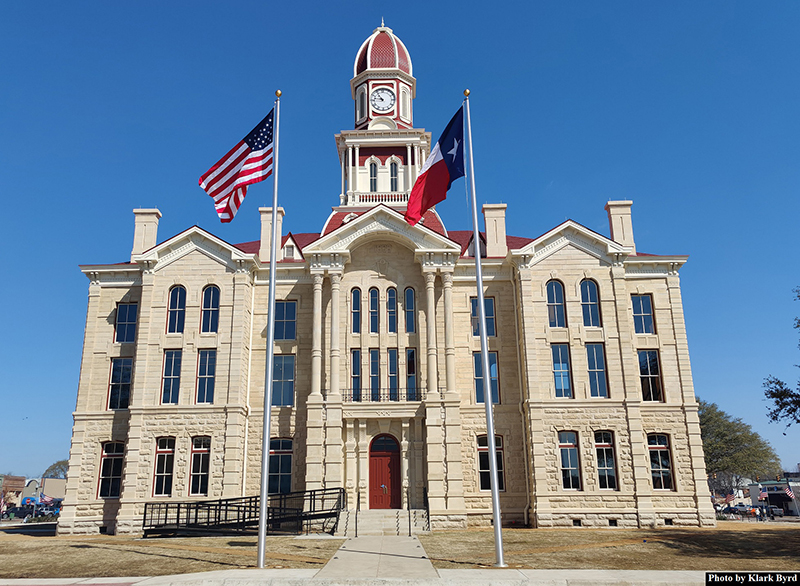
The historic Fannin County Courthouse stands in downtown Bonham, Texas, the hometown of IMCA Stock Car standout Shelby Williams. The city, located in Texoma along the Texas-Oklahoma border, traces its roots to 1837 and is named for Alamo defender James Butler Bonham. (Photo by Architexas)
A Century Mark in Texas Dirt
Williams’ climb to the Century Club has been built on consistency as much as speed. His first Sunoco IMCA Stock Car victory came in 2016 at Southern Oklahoma Speedway — a breakthrough moment that validated years of learning, late nights in the shop, and laps turned across the region. From there, the wins began to stack, highlighted by a career-best 17 triumphs in 2017. Additional double-digit seasons followed in 2018, 2020, 2021, and 2023, underscoring sustained excellence rather than short bursts of dominance.
That 2017 campaign remains historic — track championships at Southern Oklahoma Speedway in both the IMCA Stock Cars and the Smiley’s Racing Products IMCA Southern SportMods, along with Oklahoma state titles in each division. He later added the 2020 Kennedale Speedway Park championship and marquee crowns including All-Star Shootout titles in 2023 and 2024, the 2025 Winter Nationals championship, and the 2026 Texas Shootout title at I-37 Speedway in January.
Away from the track, Williams balances racing with his wrap business, Team Nine Designs, that demands long hours and late nights — a reality that keeps him grounded despite racing accolades.
His friends keep it lighthearted.
“They’ll put a note on my door that says, ‘Out of business because he’s always racing,’” he laughed.
As he reflected on the milestone, gratitude came first.
“I want to thank my family and my wife for letting me be gone all the time,” he said, also recognizing a long list of partners who support the operation.
One hundred wins speak to longevity, resilience, and evolution in a division where competition deepens every year. For Shelby Williams, the number represents more than statistics.
It represents shop lights after school, family rivalries turned marriages, and a number — 82 — carried through generations.
And in Texas dirt racing, legacies like that don’t slow down once they reach triple digits.