
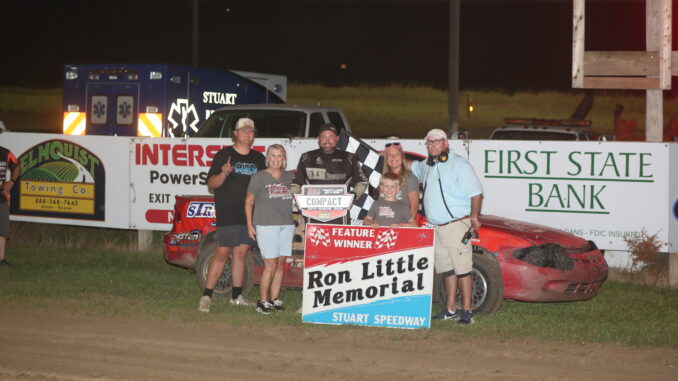
By Ben Deatherage
ALVORD, Texas (Apr. 29, 2026) — In a small North Texas town where the highway hum never really fades and cattle trailers roll past more often than commuter traffic, Stephen Stiteler has built a life defined by movement.
Alvord, Texas, sits just north of the Dallas-Fort Worth metroplex—a quiet place with deep agricultural roots, where a park, a bank, and a handful of local businesses make up the heart of town. But just down the road lies something much bigger: the Fort Worth Stockyards, rodeo arenas, and a culture built around livestock and long days on the road.
For Stiteler, it was the perfect fit.
Because long before racing entered the picture, the road already had.
A Life Before Racing
Stiteler didn’t grow up chasing dirt track wins.
“I raced go-karts when I was about 12 or 13, but only for a year,” he said. “I had three siblings and we were always busy with sports, so racing kind of went away.”
Instead, his path took a different direction—one that kept him just as competitive, just as driven, but far from the racetrack.
For nearly two decades, he was immersed in rodeo.
“I rodeoed for about 18 years,” he said. “I was a team roper.”
It was a lifestyle built on long hauls, early mornings, and late nights—traveling from one event to the next, often with little rest in between. It demanded discipline, mental toughness, and the ability to perform under pressure, no matter the conditions.
Those same traits would later translate seamlessly into racing.
“A girl I was dating got me into it,” he added. “I had never even been around a horse—not even petted one—until I was 21 years old.”
But once he got into it, he was all in.
Rodeo became more than just competition—it became a way of life, with the road trips, the routines, and the grind.
“Sometimes the rodeos were at the infields of racetracks,” he said. “I’d be able to watch dirt track racing while I was there.”
Even after stepping away from racing as a kid, that connection never completely disappeared.
That spark stayed with him.
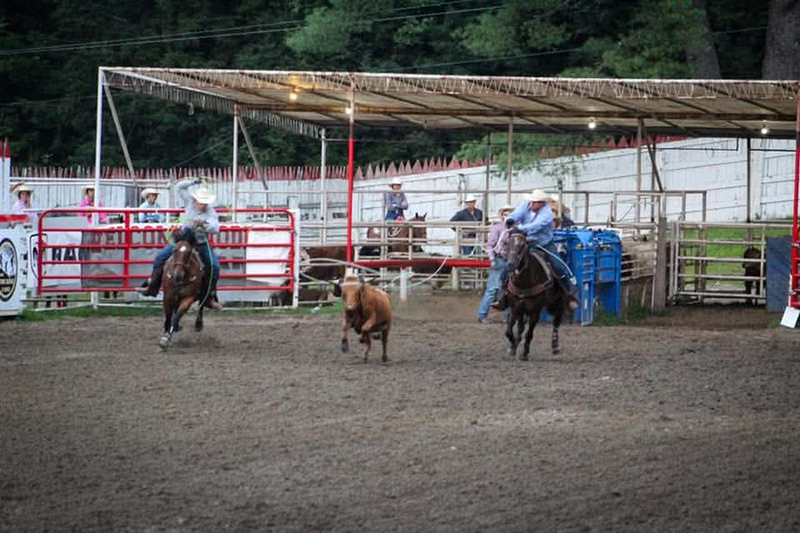
Stephen Stiteler (right) competes at the world-famous Painted Pony in Lake Luzerne, New York, during August 2021, marking the final run on his head horse before its retirement at 22 years old. (Courtesy Photo)
Built on Competition
Growing up in Rochester Hills, Michigan—about an hour north of Detroit—Stiteler was surrounded by competition from an early age.
“My family went to all the big pavement races—Michigan, Indianapolis, Daytona,” he said.
His father was friends with Dale Earnhardt and became close with his longtime crew member Chocolate Myers.
Stiteler even raced against Brad Keselowski at a young age.
“We lived a few miles apart and raced against each other.”
With four siblings spread across nearly a decade, weekends were packed with games, practices, and travel.
“Every weekend we were at a sporting event, and during the week there was a practice almost every night,” he said.
He played everything—soccer, baseball, golf—but basketball became his strongest pursuit.
“I had a Division I offer my junior year,” he said. “But I got hurt and couldn’t take it.”
Also during high school, Stiteler had launched a landscaping and hardscaping business—one that quickly grew beyond expectations. What started as a small operation turned into something that demanded full attention.
After going to community college for two years, he enrolled at Central Michigan University to study business entrepreneurship. But as his company grew rapidly, he was forced to make a choice.
He came home—not because he had to, but because the opportunity was too big to ignore.
A Business Built by Accident
After moving to Texas in 2013 to pursue rodeo full-time—drawn by the opportunity to train and compete year-round instead of Michigan’s shorter season—life took another unexpected turn.
In early 2014, Stiteler’s 19-year-old brother, Matthew, was killed—an event that changed everything.
“I started going back and forth a lot more to Michigan to see my mom and dad,” he said.
With one sister, Sarah, working as a producer for Warner Bros. in Los Angeles, and another, Allison, settled in Detroit, Stiteler found himself in a unique position, with the flexibility to move between worlds.
And in doing so, he unknowingly created something new—STR Transport.
“I’d take my horse back and forth to rodeo, and I had extra spots in the trailer,” he said. “I started telling people I could haul theirs too.”
At first, it wasn’t a business. It was just helping out—covering fuel, making connections, and doing whatever needed to be done.
“When I first started, my rodeo buddies would call me and prank me,” Stiteler said with a laugh. “They’d ask me how much it would cost to haul something crazy like 13 llamas somewhere.”
Before long, though, the joke was on them.
“I got a bigger trailer so I could haul my own horses and six for other people,” he said.
From there, it took off—what started as a side hustle quickly turned into a full-scale operation—one built on trust, reliability, and the willingness to go anywhere.
And he meant anywhere.
“I’ve hauled horses to Alaska, the Grand Canyon, Las Vegas, to Miami International Airport to ship out animals to the British Virgin Islands, Hawaii, and Germany. I’ve been everywhere,” Stiteler said.
The job became more than transportation—it became an experience, and in many cases, something more meaningful.
Stiteler has transported countless horses, including many rescued from slaughterhouses, helping get them to new homes where they’re given a second chance.
Each trip brought new people, new challenges, and stories few could imagine.
From hauling horses to high-profile clients—including a delivery involving the Kardashians—to one of his most unusual jobs—transporting 11 zebras from Miami to Puerto Rico before they were shipped via boat to a private island in the British Virgin Islands—no two jobs were ever the same.
At first, even he didn’t believe it.
“I thought the zebra call was a prank,” Stiteler said.
To be sure, he reached out to his sister Sarah. She was able to check a database of celebrity and high-profile contacts to verify the caller.
“It turned out to be legit and was from a woman featured in Forbes magazine,” he said.
And just like that, one of the most unusual hauls of his career was real.
Stiteler has also transported rescue horses to Willie Nelson’s ranch near Austin, where they’re given a place to live out their days.
“That’s one of the cooler things we’ve gotten to do,” he said.
Still, not every job came without risk.
“We’ve hauled everything—horses, cows, even lemurs,” he said. “But zebras are the wildest. They’re not domesticated—they’re true fight-or-flight animals. They’ll either run until they hurt themselves or turn around and try to hurt you.”
Beyond the unusual cargo, there was something more personal about the work.
Unlike his earlier landscaping business—where he might never meet the customer—this brought him face-to-face with people across the country.
“You meet people everywhere,” he said. “You’re part of the process.”
For more than a decade, the business grew rapidly—mirroring the success he had seen before.
After years on the road, Stiteler found himself ready for something new. But the lifestyle—the movement, the constant travel, the unpredictability—never really left.
It led him back to racing.
Finding His Way Back
After 18 years in rodeo, Stiteler made a decision.
“I just said, ‘I’ve had enough of this—I want to try racing.’”
It wasn’t a gradual shift.
It was a return to something that had been sitting in the background for years—something he had never fully let go of. Before long, he was behind the wheel of a Mach-1 IMCA Sport Compact.
And almost immediately, his background gave him an advantage.
In rodeo, long overnight drives and back-to-back events were normal. It wasn’t unusual to compete one night, drive 12 to 14 hours, and be ready again the next morning. That mindset carried over seamlessly.
“I figured I could go to Iowa midweek, Kansas on Sundays. I was just trying to find more races,” he said.
Where others saw distance and logistics, Stiteler saw opportunity.
More races meant more experience.
More experience meant results.
That approach paid off in a big way.
In 2023, Stiteler earned IMCA National Sport Compact Rookie of the Year honors.
“It was pretty cool,” he said.
But the path to that title was anything but straightforward.
It came down to the final weekend of the season in Concordia, Kansas—and even then, it wasn’t decided on the track alone.
Stiteler finished the year tied in points—and not just with anyone. He was locked in a battle with Callee Gaston, a fellow competitor, close friend, and someone whose journey had mirrored his own from the very beginning.
The two had started their rookie seasons around the same time, living roughly an hour apart, helping each other along the way while still competing against one another week after week.
“We were neck and neck the whole time,” Stiteler said.
It made for a unique situation—two friends pushing each other forward, knowing only one would come out on top.
As the season wound down, circumstances began to shift.
Gaston was still in high school, balancing racing with cheerleading and school commitments. As those responsibilities took priority, her schedule limited the number of races she could attend late in the year.
Still, it came down to the final weekend—and even then, it was too close to call. The championship was ultimately decided on a tiebreaker—most full-point wins—giving Stiteler the edge.
Today, he continues to push forward in the division and just like everything else in his life, he’s not slowing down.
He’s planning extended racing trips across the Midwest, stringing together races the same way he once did with rodeos—one stop after another, wherever the next opportunity takes him.
“I’m planning on running hard for a couple weeks straight—racing almost every night,” he said.
A Texas Home Base
Alvord, Texas, may be a small town, but its roots run deep.
Originally established in the early 1880s along the Fort Worth & Denver Railway, the town grew as a hub for agriculture, ranching, and trade—serving as a center point for farmers and cattle operations across Wise County. Over time, it remained a quiet but steady presence in North Texas, shaped by the same industries that still define the region today.
For Stiteler, it offered something familiar.
“It was just more affordable than living closer to Fort Worth,” he said. “But I’m still only about 45 minutes from the north side of town and the Stockyards.”
The Fort Worth Stockyards—one of the most recognizable centers of Western heritage in the country—became a regular stop during his rodeo years, hosting events on Friday and Saturday nights that drew competitors and fans from across the region.
And just like growing up in Michigan, where he could make the drive to watch the Red Wings, Pistons, or Lions, Stiteler found a similar rhythm in Texas.
Within an hour, he could be in Dallas or Arlington—catching a game, a rodeo, or another event—while still returning home to a small-town setting.
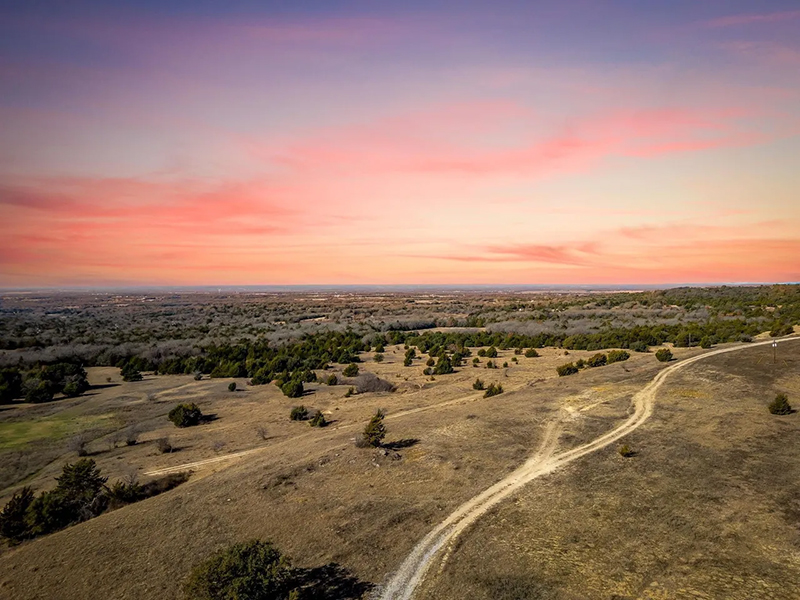
Rolling terrain surrounds Alvord, Texas, where Stephen Stiteler now calls home after moving south in 2013 to chase life as a full-time rodeo competitor. (Photo from Realtor.com)
Life in Motion
Even outside the racetrack, Stiteler’s life rarely slows down.
Whether hauling livestock across the country or preparing for the next race, movement has always been a constant.
“I feel lucky,” he said. “There’s a lot of people who don’t get to do the things I’ve done.”
And through it all, one thing has remained consistent—he always keeps moving forward.
Stiteler is quick to credit the people who have helped along the way, from the Leasure family, who offered guidance early in his racing career, to longtime friends like Ronnie Gaston, support has always been there.
Blake Andrus plays a key role in keeping his equipment race-ready, often working on the car while Stiteler is on the road. Kollin Teafatiller also travels with Stiteler hauling horses, helping with hooking and unhooking trailers and managing the constant transition between work and racing.
He also thanks his partners, including his business STR Transport, Mark’s Mobile Trailer Repair, 52 Fab, Richards Speed Shop, WEB Chassis, and Andrus Racing, among many others who help make it all possible.
From Michigan to Texas.
From rodeo arenas to dirt tracks.
From hauling horses across continents to chasing checkered flags.
Stephen Stiteler’s journey has never followed a straight line.