By Ben Deatherage
CHEYENNE, Wyo. (Dec. 17, 2025) — In southeastern Wyoming, the wind never really stops, and distance is simply part of the landscape. Highways run long and empty across open plains, rising into mountain passes before dropping back into wide-open country where weather sets the rules. For Troy Seidl, racing out of Cheyenne has always meant accepting that reality — that every season begins on the road long before it ever reaches the racetrack.
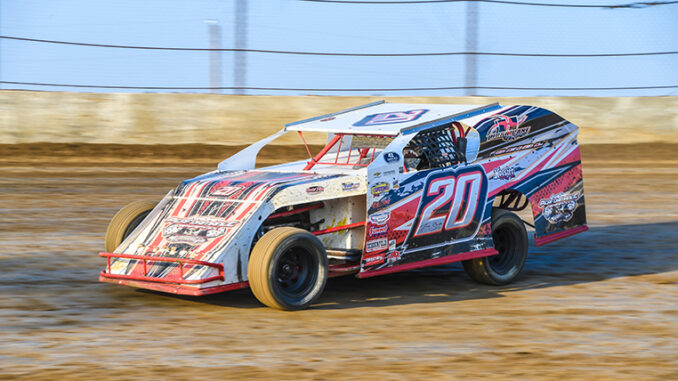
In 2025, those miles turned into momentum. Seidl put together one of the strongest seasons of his career in a Friesen Performance IMCA Modified, earning track championships at Cortez Fairgrounds Speedway and Mosca Motorsports Park while also claiming titles on the Colorado Alliance Tour and the Colorado State championship. The success followed earlier milestones, including the 2023 Colorado State title and a Phillips County Raceway track championship.
The Long Road to the Racetrack
From Cheyenne to Cortez, Colorado, the drive stretches roughly 11 hours and crosses Wolf Creek Pass at more than 11,000 feet, ending just miles from the New Mexico border. It’s a haul that tests patience and planning long before the first green flag ever waves. That same reality played out all season, with additional trips east to Lincoln County Raceway in North Platte, Nebraska, turning nearly every weekend into a long-distance commitment.
“It’s quite a journey,” Seidl said. “You go from one side of Colorado completely to the other.”
Weather became a constant variable throughout the season. Seidl joked that he turned into a part-time meteorologist, watching radar and forecasts in hopes of staying ahead of cancellations.
“I’ve been a big fan of the weather channels lately,” he said. “We only got rained out twice all year — once in Nebraska and once at Mosca — so we were pretty lucky.”
That luck was tested early. On a Thursday night trip toward Cortez, his Dodge truck went into limp mode after an exhaust system failure, lighting up the dashboard before he even cleared Colorado’s mountain roads.
“We were going to leave early so we had plenty of time,” Seidl said. “The light came on, it went into limp mode, and I turned around to see if I could borrow a truck. Nobody really had one.”
With no other option, Seidl pressed on.
“I went to the local dealer here in Cheyenne and they told me to just drive it,” he said with a laugh. “So I drove all the way to Cortez with the check engine light on and said, ‘Come hell or high water, I’m going to race.’”
The truck held together long enough to get him to the track. It failed three weeks later on the way home, but by then he was able to secure a loaner truck.
Learning the Hard Way
Seidl’s racing foundation was built years earlier in Cheyenne. His father, Mick, owned a body shop and painted race cars, a skill set shaped in part by his time as a tank mechanic in the U.S. Army during the Korean and Vietnam eras. Saturday nights were spent at the local pavement track, watching from the stands and absorbing everything he could.
“One thing led to another,” Seidl said. “I started helping a guy every Saturday night, and it got to the point where I told myself, ‘I’ve got to do this.’”
He began racing Mini Stocks in 1984 and eventually climbed into pavement Late Models. In 1993, he earned rookie of the year honors and followed it with a track championship the next season.
“I grew up watching it,” he said. “My dad drag raced a little bit, but he didn’t like circle track racing much. He thought they tore stuff up too much. I told him, ‘They’re not supposed to.’”
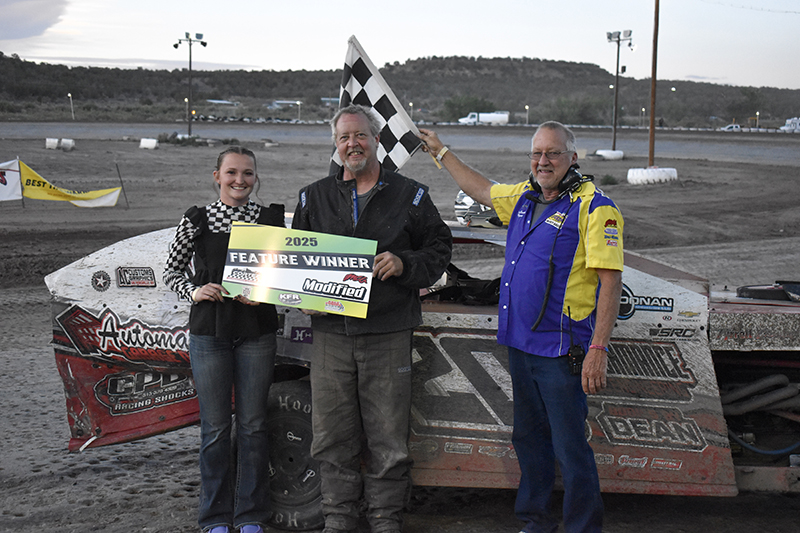
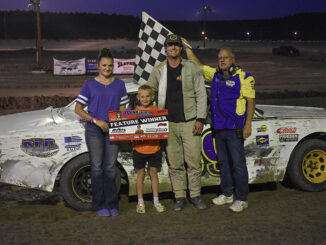
Troy Seidl celebrates in Victory Lane after a Friesen Performance IMCA Modified feature win at Cortez Fairgrounds Speedway on July 26, a key stop in his championship-winning 2025 season. (Photo by Candid Moments by Shandra)
Home on the High Plains
Cheyenne has always been a place shaped by motion and resilience. Founded in 1867 along the Union Pacific Railroad, the city rose almost overnight as a supply hub for crews pushing steel rails westward across the plains. Workers, merchants, and soldiers followed, building a town where permanence was earned rather than assumed. They called it the “Magic City of the Plains,” not for comfort, but for speed — because if you didn’t keep moving, you got left behind.
The railroad brought Cheyenne into existence, but the wind kept it honest. Settled on the eastern edge of the Rockies, the city sits where weather rolls down off the mountains and sweeps across open country with little warning. It’s a place where preparation matters, where long distances and hard conditions aren’t obstacles so much as expectations — and where those who stay learn to use the land when the weather allows, climbing the granite at Vedauwoo or fishing the high-country lakes during the short summer months.
That character never really changed. Fort D.A. Russell — later Fort Francis E. Warren — anchored Cheyenne as a military town, reinforcing its role as a place people passed through on their way west, or returned to when duty called them home. When Wyoming became a territory in 1868, and later a state in 1890, Cheyenne remained its capital, a quiet constant in a region built on movement.
Today, the highways that once carried wagons and rail crews now carry race haulers and freight trucks, stretching south toward Colorado and east toward Nebraska. The geography hasn’t softened. The wind still blows. The miles are still long.
“You’ve really got June through August to enjoy the outdoors,” Seidl said. “After that, the weather takes over.”
He’s seen that weather at its worst.
“The wind blows unbelievably here,” Seidl said. “We’ve had 100- to 120-mile-per-hour winds. Last week, 40 semis tipped over across the state. From Laramie to Cheyenne and Cheyenne to Casper can be very dangerous.”
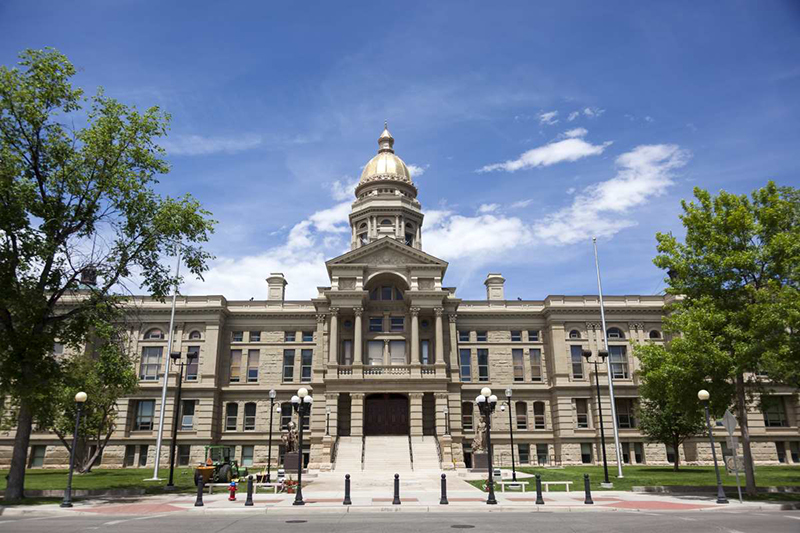
The Wyoming State Capitol building in Cheyenne stands as a landmark of the city Seidl calls home, where long distances, wind, and history shape everyday life on the high plains. (Photo by AreaVibes.com)
Changing Surfaces, Changing Life
Life eventually shifted. After getting married, Seidl moved to the Houston area of Texas, where asphalt racing opportunities were limited. He sold his pavement equipment and purchased an old Modified, beginning the transition to dirt racing.
“The Late Model was easier to drive,” he said. “The Modified is harder because of the small tires. It was a big stepping stone in my driving career.”
While racing in Texas, a chance meeting altered his trajectory. IMCA standout Kelly Shryock stopped by one day in his pit, struck up a conversation, and offered guidance that stayed with him.
“He was the nicest guy in the world,” Seidl said. “That conversation changed everything. I ended up getting a chassis from him, and honestly, if that hadn’t happened, I probably would have quit.”
Five years ago, Seidl returned to Wyoming to be closer to his mother, Linda, who was battling Alzheimer’s disease. She passed away just weeks after he arrived.
“It was hard,” Seidl said. “There were times she didn’t know who I was and asked me who I was, and I said, ‘I’m your son.’ I went to the bathroom, came back, and she asked me how my day was like nothing had happened.”
Back in Cheyenne, Seidl returned to familiar ground, working in the body shop at Tyrrell Chevrolet and slowly finding his way back into racing.
“I pretty much got back into it once I was home,” he said.
As the season closed, Seidl reflected on the people who helped him make it possible.
“I want to thank Glen Tilton with NAPA Auto Parts, Kelly Shryock for all his help, Howard Willis from my Texas days, and everyone I grew up with and looked up to,” he said. “And I really want to thank my girlfriend, Amanda Newton. She went to every race with me this year and was a huge supporter. Also, my sponsors Tyrrell Chevy and Honda, NAPA Auto Parts of Cheyenne and Laramie, Automatic Garage Door, Bodies by Dean, CPD Shocks, Performance Race Engineering, A.C. Custom Graphics, Sneaky Horse Traction Augmentation, Day Motorsports.”
For Troy Seidl, championships matter — but they’re only part of the measure. The real story is written in miles, in wind, and in the choice to keep going from a place that has always demanded commitment from the people who call it home.
Out here, Cheyenne still does.